© 2024–2026 Course Correction Consulting Ltd. All rights reserved. LEAD with EASE™ for Organisational Judgement is James Hardie’s distinctive double mnemonic and applied model, developed in April 2025 and first published on 23 July 2025.
.svg)
.svg)


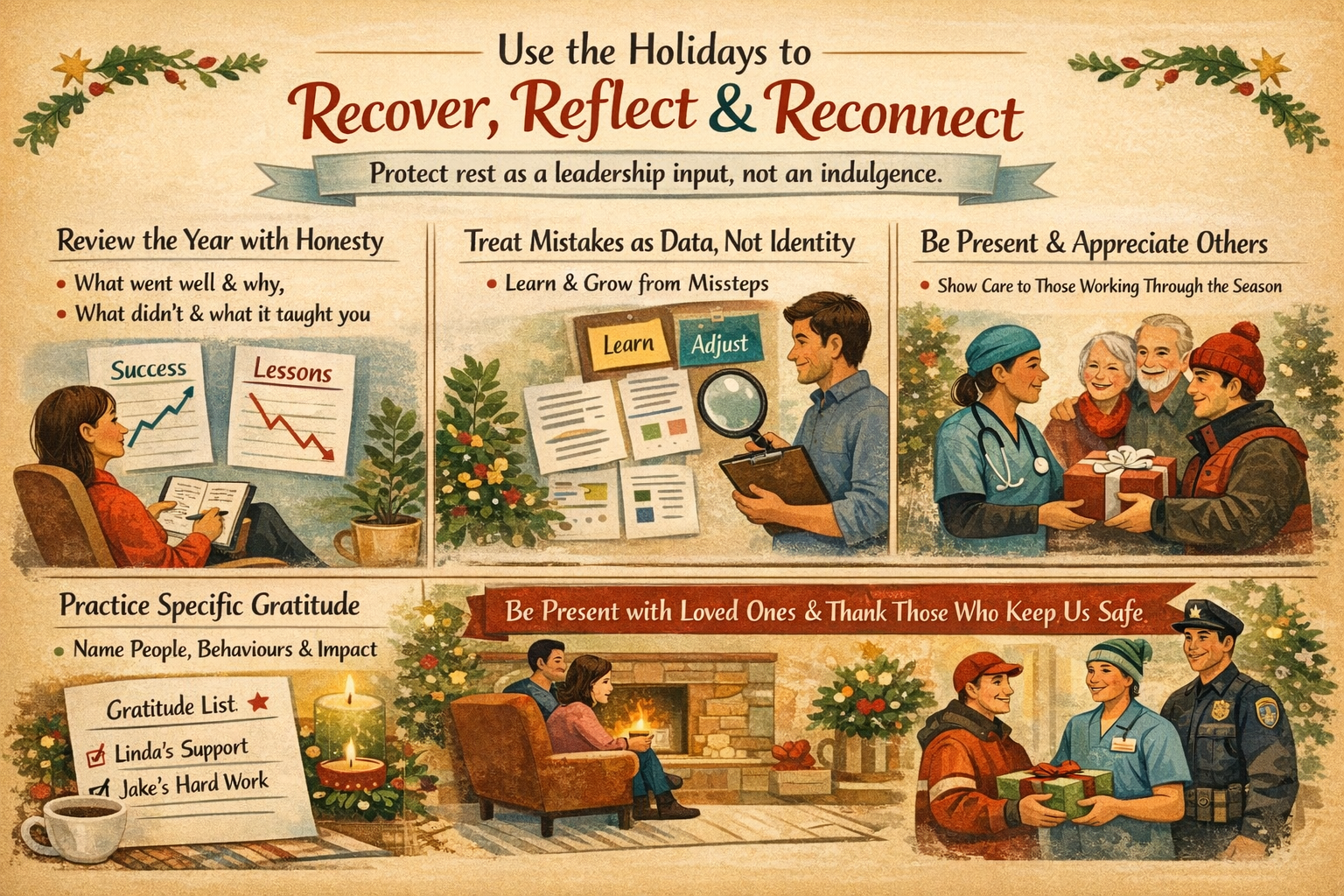
A way to Reflect on what has been achieved and what still needs to be done.
Use the holidays to recover, reflect, and reconnect. Protect rest as a leadership input, not an indulgence. Review the year with honesty: what went well and why, what did not and what it taught you. Treat mistakes as data, not identity. Practise gratitude with specificity, name people, behaviours, and impact. Be present with those who support you, and extend visible appreciation to those working through the season to keep others safe.
As you take time off this Christmas, business owners and others with leadership responsibilities, may find this a more difficult time to break away.
Cut yourself a break and pat yourself on the back, you made it this far already and now you get to celebrate a little if you try. Use this framework to consider a bigger picture, how the little things may be the big things and what is your real priority number one and only!
To have the strength for two you must also maintain the strength for you. In Mind, Body and Spirit.
Take one sheet of paper. Two columns. Done well: What worked, what conditions made it work, and what you personally did that you should repeat. Not done so well: Where reality beat the plan, what assumptions were wrong, and what you learned. This is not self-criticism. It is sensemaking. Life is a lesson, but only if you extract the lesson.
For a few days, let your values be visible in your diary and your actions. Put your phone down at the table. Ask better questions, enquire about others and their feelings with open questions and find a resonance. Listen and listen some more, without preparing your next point or telling your story. If you are constantly “on”, you are training everyone that you are unavailable in spirit, even when you are in the room.
Fatigue and poor sleep degrade attention, judgement, and emotional regulation, which is a polite way of saying mistakes become more likely and conversations become harder than they need to be.
If you want a practical recovery lens, Sonnentag and Fritz’s work is useful: detach, relax, do something absorbing that is not work, and choose how you spend your time. Find other activities to thrive in and release your sub-conscious to make its connections.
It is okay to make mistakes, if you can learn from them. What matters is the repair: name it, learn it, adjust. If you are leading others, model this explicitly. You teach people what “safe to learn” looks like by how you respond when things go wrong.
"If you can keep your head when all about you are losing theirs and blaming it on you" Excerpt from If, by Rudyard Kipling, 1895
Do gratitude properly. Three messages, short and specific:
1) what you noticed, 2) why it mattered, 3) what it enabled.
Thanks for sticking around to help me get ready for tomorrow, I should be able to get home in time for...
There is evidence that structured gratitude practices modestly improve wellbeing. The point is not sentimentality, it is strengthening relationships and attention to what is working. And to those working this season. If you find this awkward then practice it a little more and keep it simple.
If you see someone keeping the lights on, NHS staff, emergency services, carers, transport crews, hospitality teams, give them a smile and a simple thank you. These small moments are part of how societies hold together.
Bear in mind false flattery and gratitude can become toxic if it is used to silence legitimate frustration. Rest is also unequally distributed, some people cannot easily switch off. If that is you, choose the smallest possible reset and develop your coping strategies: breathwork and mindfulness, one earlier night, one walk, one honest conversation, one boundary.
You have managed and coped with unexpected challenges, there have been ups and downs throughout the year and no boubt more to come. However, you have gained experiences in both success and failure. Learn from what you have done and what others have done with you and for you, because life goes on...
Keep Going!
How do I rest when the business never stops? Define “minimum viable recovery”, protect sleep, and delegate one operational decision for a week. https://www.coursecorrection.co.uk/knowledge-centre/how-do-i-scale-a-business-without-burning-out
What if reflection just makes me feel guilty? Constrain it to 20 minutes, focus on causes and conditions, then pick one change.
How do I thank people without it sounding performative? Be specific about behaviour and impact, and do it privately as often as publicly.
How do I turn mistakes into a system improvement? Write the “trigger, choice, outcome”, then change the trigger or the choice next time.
Selected References
Agyapong-Opoku, F., Agyapong-Opoku, N., & Agyapong, B. (2025). Examining the effects of sleep deprivation on decision-making: A scoping review. Behavioral Sciences, 15(6), 823. doi:10.3390/bs15060823
Choi, H., Cha, Y., McCullough, M. E., Coles, N. A., & Oishi, S. (2025). A meta-analysis of the effectiveness of gratitude interventions on well-being across cultures. Proceedings of the National Academy of Sciences of the United States of America, 122(28), e2425193122. doi:10.1073/pnas.2425193122
Course Correction Consulting Ltd. How do I scale a business without burning out? Knowledge Centre. Retrieved December 22, 2025.
Sonnentag, S., & Fritz, C. (2007). The Recovery Experience Questionnaire: Development and validation of a measure for assessing recuperation and unwinding from work. Journal of Occupational Health Psychology, 12(3), 204–221. doi:10.1037/1076-8998.12.3.204
Xu, W., Wang, L., Yang, L., Zhu, Y., & Chen, P. (2024). Sleep deprivation alters utilization of negative feedback in risky decision-making. Frontiers in Psychiatry, 15, Article 1307408. doi:10.3389/fpsyt.2024.1307408