© 2024–2026 Course Correction Consulting Ltd. All rights reserved. LEAD with EASE™ for Organisational Judgement is James Hardie’s distinctive double mnemonic and applied model, developed in April 2025 and first published on 23 July 2025.
.svg)
.svg)


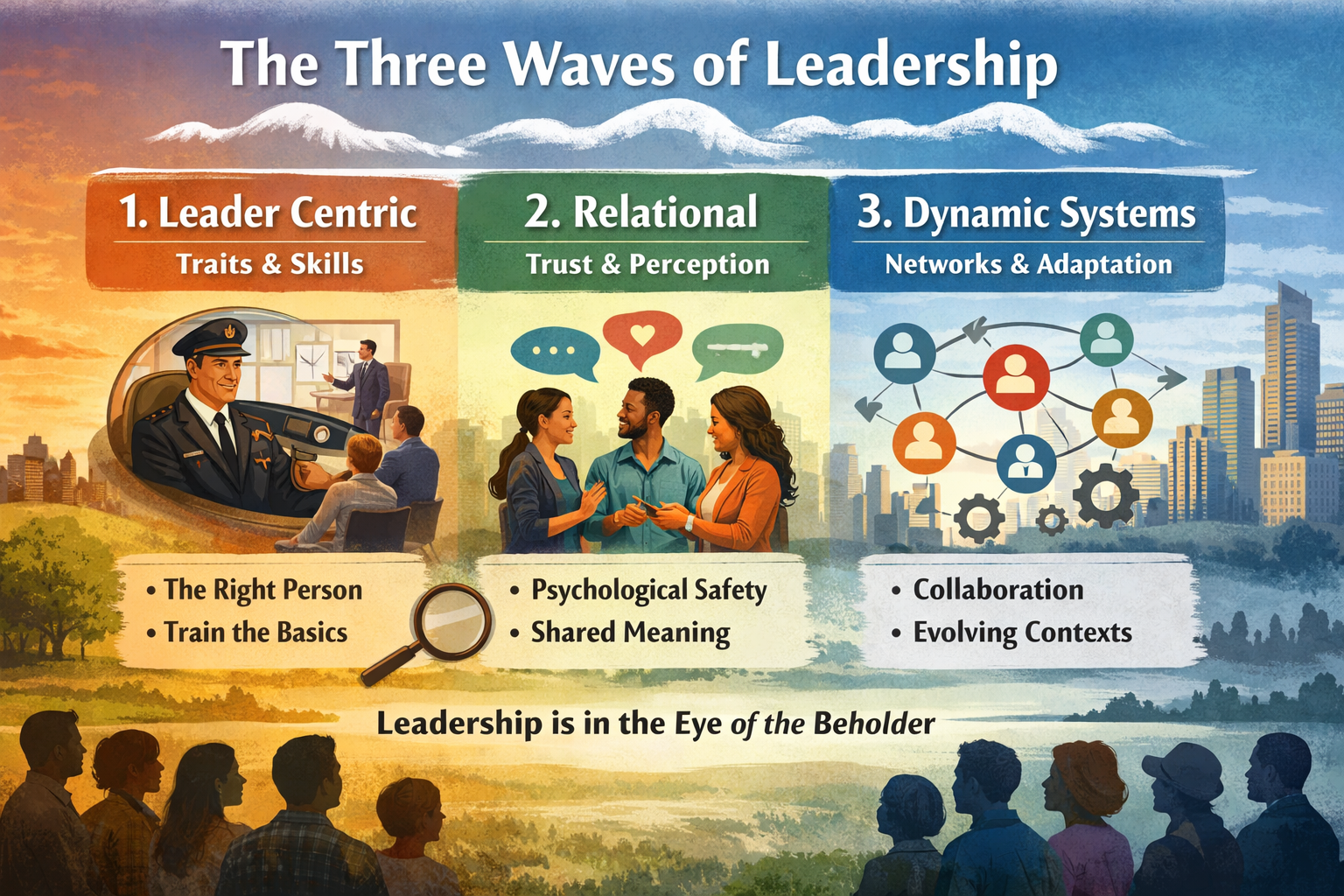
Leadership research has moved through three waves in academic research (Lord et al.): leader traits and behaviours, relationships and perception, then dynamic systems and networks.
Leadership research has moved through three waves in academic research (Lord et al.): leader traits and behaviours, relationships and perception, then dynamic systems and networks. Yukl’s work keeps us grounded in what leaders actually do, clarifying goals, aligning roles, and adapting behaviour to context. Avolio and Gardner add the integrity test where credibility comes from consistent, transparent practice. Grint provides for me the essential scepticism where leadership is often socially constructed, so question whose interests a framing serves. The ancient playbook still applies in decision forcing moments where practical wisdom, clear intent, and composure still matter. Use EASE to diagnose the context, align expectations, support trust, and empower distributed action.
Mastering the Art of Course Correction to LEAD with EASE delves deep into the strategies and mindset shifts you need to realign your goals and reclaim your path. This week, we start the year by upgrading how we might think about leadership, so our practice is less performative and more effective. This covers a few of my favourite sources for understanding the study and implications of leadership.
Leader Centric - Great man theories and being saved
Relational interactions between leaders and followers and everything in between
Dynamic Systems and design
Couple this modern analysis and critiques, with ancient sources of wisdom such as:
Aristotle. Nicomachean Ethics.
Sun Tzu. The Art of War.
Thucydides. History of the Peloponnesian War.
Machiavelli. The Prince.
von Clausewitz, C. On War.
Leadership actions might be understood more easily and expressed more effectively, when you adapt any approach to the kind of situation you are in, then design the conditions for good judgement by all who will be judging and following you, or not.
I would suggest that you are not one or other of a type of leader, though you may hear people self attribute towards certain perceptions of good leadership, be that authentic, servant or any other. However, understanding this is part of learning how to lead effectively.
Leader centric thinking tempts us to hunt for the “right person”, quite often a 'great man' (Carlyle), a saviour. Somewhat useful, but limited and perhaps of its time. Traits and behaviours matter, yet they rarely explain why good people fail in messy contexts. The fact is that if leadership was needed it already was a messy context or else a managed solution or process would do.
However, all too often this was about status and rank, which are often useful indicators of some experience, but may not be enough in the most novel of situations. History takes incomplete notes and the narrative is shaped by the victors, great or otherwise. Those around them also want to take the accolades and thus loyalty becomes an end in itself.
According to the Great Man Theory, effective leaders are believed to possess certain traits, including: Charisma: The ability to attract and inspire followers. Intelligence: A high level of cognitive ability and decision-making skills. Courage: The willingness to take risks and face challenges head-on. Decisiveness: The ability to make firm decisions quickly and effectively.
Relational research shifts the spotlight to trust, identity, and perception. In practice, your authority is often borrowed, not owned. People watch for coherence between your words and your choices. Values beliefs and behaviours may create alignment or dissonance among followers.
Dynamic systems asks a harder question: what patterns are we creating and why are they valid? Here, leadership becomes the design of information flow, decision cadence, and shared sensemaking over time. However, the appearance of systems defined may create restrictions when leadership is required despite management.
Grint’s critiques of leadership, may be the necessary corrective because “leadership” can become a label used to legitimise power, a social definition and also a personal preference that justifies an action.
So you may ask, “Who is defining the problem, who benefits from that definition, and what alternative framing produces better outcomes?”
The benefits of creating leadership at all levels in your organisation may also be uncomfortable and challenging. Boundaries are still required, trust can still be betrayed by personal ambitions, perhaps the dark triad of leadership (manipulation, narcissism and psychopathy) will gather together. The hierarchical structure may still be climbed as an end in itself as opposed to advancing the purpose of the people and the organisation.
Case studies and historical records allow us a chance to ask what might we have done, and compare this to what was done and what reportedly happened. This is also a basis of ethics courses such as those provided in military training. The discipline of reviewing decisions, providing feedback and taking actions to prevent future issues can be established in a safer more abstract environment.
However, when time is short and stakes are highit is worth noting that the classics converge on a few themes, such as application of practical wisdom (Aristotle), clarity of aim and positioning (Sun Tzu), and steadiness under pressure (Aurelius, Epictetus and Stoic thought). Modern leadership theory often agrees, under stress you need intent, role clarity, and disciplined judgement, not performative theatre (though plenty of performance remains)
1) Which wave should I lead with? The wave models is an academic timeline view, it is not a definition of how to lead. There is no definitive way to look at leadership (though followers are important), not least because situation and context is the key to decision making, and often people prefer and justify their own style (Grint). However, you might consider:
If the issue is competence, then you may start with who should lead?
This leader centric approach must also bear in mind that competence or rank may not create followers, lack of it may lose them. Create clarity and competence in your teams, understand roles and remits, set boundaries and ensure regular debriefs. In this way the most junior may lead in certain circumstances with willing followers.
If the issue is trust and meaning, then relationships are critical as ideas are explored and why is understood.
If the issue is recurring friction and managing your systems, which may be defeating your people, then ask how we can improve the existing method that has worked. Bear in mind that someone may be protective of their system. Leadership may need to establish a workaround that is temporary or persistent, and thus the system is updated if needed. Co-creation can bring buy in when complexity creates greater uncertainty
2) How do I stop leadership becoming personality driven? Leadership inevitably questions the status quo or a path that is being followed and who is leading on that path. To question this may take courage and other personality traits, but it can also be made easier with a structure.
Write out intentions (think about values and beliefs), decision rights, and review cadence and behaviours. This will help to structure your leadership culture and its capacity to adapt and evolve. Make the system carry the load, not your charisma or anyone elses because when you are inevitably wrong you will have support.
Charisma has immense value in relationships but it has issues which may lead to bad outcomes in leadership and decision making. Check decision making structures, avoid binary options and ensure all offered options are truly viable, not just bad alternatives. Build a culture of loyal dissent and encourage it because the competition will always thank you for your lack of consideration of the problems you built in.
3) What does “authentic leadership” look like when it is hard? Are you being authentic and what does it really mean for you? This is a good start, because you will be seen one way or another and judged. Leaders are always on pedestals.
"Remember, when you are a General you are always the General."
Sometimes there are no good options, just less bad ones. Consistency between values, decisions, and communication, especially when the choice costs you something may gain you the support you need to build and take decisions. However, authentic leadership can be hardest when other values and behaviours do not support it. Consider the challenger who takes the lead and is found wanting, who else was also willing to challenge? When authentic leaders fail they may learn, and this is hard won, so beware of failing them at this moment of difficulty.
4) How do I challenge leadership and decision making without becoming cynical? Treat it as a safeguard and create systems that encourage people to ask, what have we missed? Leadership is a collaborative endeavour and rarely required to be used with an expectation of unswerving loyalty.
The presence and requirement of leadership indicates that there is a wicked problem to be solved, a novel course of action to be determined and uncertainty about the outcome.
Ask who and what defines success, then broaden the frame to include the people living with the consequences. You can only control so much (inputs and your outputs) and even then you may not entirely own the outcomes.
What is good leadership for you?
How do you measure it?
Selected and Supporting References:
Decision forcing and historical anchors (primary texts):