© 2024–2026 Course Correction Consulting Ltd. All rights reserved. LEAD with EASE™ for Organisational Judgement is James Hardie’s distinctive double mnemonic and applied model, developed in April 2025 and first published on 23 July 2025.
.svg)
.svg)


What is the real difference between Outputs and Outcomes, often used interchangeably or as preferred. The problem is we can own a process and its outputs, but we cannot be sure of the outcome and how it makes others feel. Or can we?
Businesses can control their inputs, processes and outputs. In modern technological manufacturing this is particularly amazing. But the outcomes live in the experience of the receiver. That means leaders need to be much clearer about what they can deliver, what they can influence, and what they should not really be claiming as their Fantasy is not necessarily another's reality. That may be okay for some of our marketing but we do still need to recognise what we truly can control and its relationship to other's outcomes.
Read or follow on LinkedIn
Have you noticed how now use the word outcomes a lot in business. Sell the outcome of your product, the emotions it creates.
Customer outcomes. Employee outcomes. Learning outcomes. Social outcomes. Leadership outcomes.
It sounds mature and compelling.
It sounds strategic and seductive.
It sounds better than saying, “Here is the thing we made,” or “Here is the work we did.”
I think we often confuse two very different things, and that may be intentional. But we do need to know the difference too.
Outputs are what we produce. Outcomes are what people experience because of what we produce.
Outputs are what we produce. Outcomes are what people experience because of what we produce.
We might also consider whether or not we really understand the Features or Fantasy we might like to create.
That difference matters because a business can design a product, deliver a training course, run a marketing campaign, create a policy, build a dashboard, hold a meeting, or send a proposal. Those are all outputs.
But the outcome sits somewhere else, in the mind, motivation, emotion, judgement, circumstances, politics, priorities and lived experience of the person receiving it.
One customer may feel confidence. Another may feel confusion.
One employee may feel trusted. Another may feel controlled.
One shareholder may see progress. Another may see risk.
One stakeholder may see innovation. Another may see harm.
The output may be the same. The outcome is very different.
Fortunately this is not a new idea to understand, though every now and then we mix up the language, for good or for ill.
The Stoics understood that we do not fully control the response of the world. We may control some of our judgement, effort, intention and conduct far more than we control reputation, approval, reward or reaction of others.
The Bhagavad Gita makes a similar point: we have a right to our actions, but not to complete ownership of the fruits of those actions.
What this means is:
Do the work well. Do not pretend you own everything that happens next.
That is not a passive idea. It is a disciplined one. It is one that I find is quite well rpodcued in martial arts too. We can learn a likely reaction to a an attack, what we cannot be sure of is move number 2, 3 or 4. Predicatability lessens the further away we move from the moment of disorder ensuing. There is always a good deal of ambiguity and this is not something that most Finance Teams like.
In effect this ambiguity asks us to take more responsibility for what we can control, because predictability may be slightly increased as we gather more data and experiences.
We create our products and services as consistently as we can and we offer them up as potential value propositions to customers
Organisational psychology helps explain why this matters so much in leadership and performance management.
If we take on the thorniest of subjects, motivation of employees.
A manager might offer a pay rise, a bonus, a new title, a development programme, public praise, clearer objectives or more autonomy.
Those are typically predictable managerial outputs, the levers of reward and recognition systems with certain limits, which are linked to extrinsic motivation.
Therefore, the outcome could be very different depending on the person, their background, their context, their education and so on and so forth.
A bonus might feel like recognition. It might also feel like manipulation.
A promotion might feel like progress. It might also feel like pressure.
A training course might create confidence, or it might sit unused because the person has no opportunity, support or psychological safety to apply it.
"The opposite of job dissatisfaction is not job satisfaction, it is no dissatisfaction" Herzberg, Two Factor Theory of Motivation
Herzberg’s work on job satisfaction is useful here. He distinguishes clearly between Hygiene factors such as pay, working conditions and policies can reduce dissatisfaction, but they do not automatically create satisfaction or motivation. They may help to alloow it to happen as they remove dissatisfaction. However, Motivation is more closely connected to achievement, recognition, responsibility, meaningful work and growth.
What this means is that you may be able to establish a positive environement. You can influence or provide the conditions. You cannot necessarily manufacture the inner outcome.
That is where many businesses and people in charge get into trouble. They say they are creating engagement, trust, loyalty, ownership or empowerment.
But often they are only creating the output that they hope will make those outcomes more likely.
That does not make the work pointless. It makes clarity and discipline essential.
The problems show up everywhere. Have a think about when you thought someone was ungrateful or at bet indifferent about what you thought you did for them.
A manager says, “We communicated the change.”
But the team says, “We still do not understand why it matters.”
Communication was the minimal output. Clarity was the desired outcome and this needed some thing extra, perhaps more emotional too.
A founder says, “We gave people responsibility.”
But the team says, “We still do not feel safe to make decisions.”
Delegation was the output signal. Empowerment was the desired outcome, but it was disconnected, perhaps by other factors.
A business says, “We delivered the project as promised.”
But the customer says, “It did not solve the problem I cared about.”
Delivery was the output. A value proposition was the desired outcome.
A company says, “We ran the leadership programme.”
But behaviour does not change.
Training was the output. Transfer, confidence and improved practice were the desired outcomes.
The tough thing to consider is a different view of the data:
Are we measuring what we produced, or are we measuring what changed for the people affected?
Both matter. But they are not the same. Objective versus Subjective. Features and Fantasy.
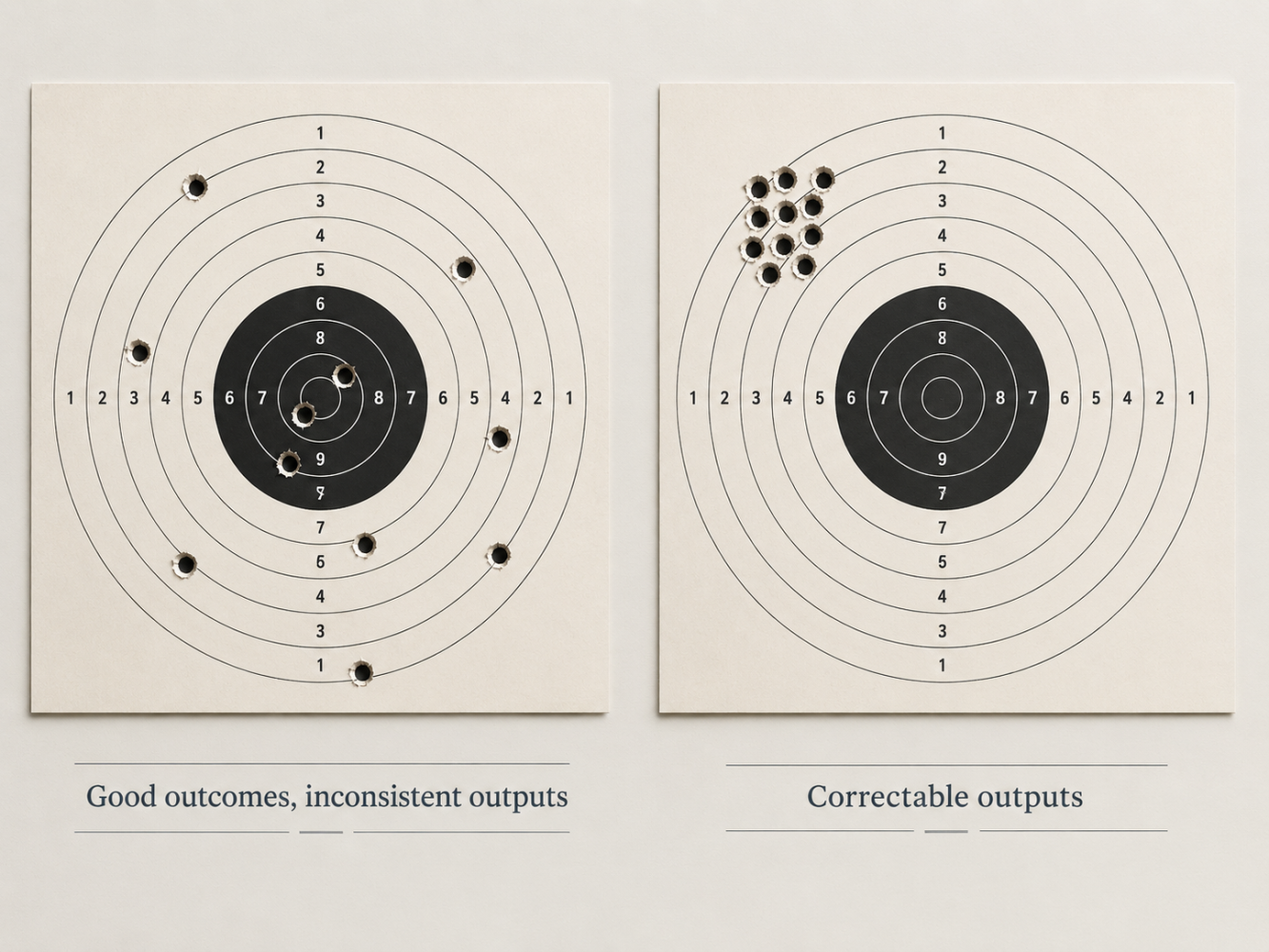
Marketing naturally speaks in outcomes. (See a couple of bullseyes here and an overall higher score on the left)
Save time. Feel confident. Grow faster. Reduce stress. Build trust. Improve performance. Lead with clarity.
That is understandable because people buy outcomes, not mechanisms.
But businesses still need to be honest about what they actually deliver because they can adjust for this, (see the target on the right)
The more responsible claim is not:
“We guarantee your outcome.”
It is closer to:
“We provide a disciplined output that evidence, experience and good judgement suggest will make your desired outcome more likely, under the right conditions.”
That may sound less dramatic.
But it is much more credible, and then we can market to "Fire for Effect."
And in complex human systems, credibility matters.
Inputs are the resources, people, information and intent we bring in. Processes are the methods, standards, systems and behaviours we use. Outputs are the products, services, decisions, communications and actions we deliver.
Outcomes are the changes, experiences, emotions, decisions or results that others live with.
Good Leadership means we should all control inputs carefully.
We should improve processes continuously.
We should define outputs clearly.
We should measure outcomes humbly.
That word, humbly, matters.
Because outcomes are shared with the customer, the employee, the market, the culture and the wider system. We may glimpse them, we cannot own all of them. We just contribute to them.
The next time someone says “outcome,” pause and ask yourself:
This is not semantics. It is more honest leadership.
It helps us avoid lazy measurement, inflated promises and self-congratulatory reporting, or settling for the scater gun score of the target on the left.
It also helps us build better organisations because we start asking better questions.
This is exactly why I use the LEAD with EASE framework.
To LEAD, we must Learn, Educate, Advise and Delegate. That means leaders need to keep learning what is really happening, educate people so they understand the work, advise without pretending to own every answer, and delegate with clarity about what is expected.
For people to be at EASE, they need to Explore, Align, Support and Empower. That means exploring the true context, aligning teams around intent, supporting the conditions for success, and empowering people to act with judgement.
In other words, leadership is not about pretending we control every outcome.
It is about becoming much more disciplined about the outputs we create, the conditions we influence, and the human outcomes we are trying to make more likely.
So here is the call to action: before your next strategy meeting, campaign, training session or performance review, ask one question: are we clear about the difference between what we are producing and what others are experiencing?
That question alone may create the course correction you need to hit the bullseye more often.
References Ancient and Modern
Aristotle. (2009). The Nicomachean Ethics (D. Ross, Trans.; L. Brown, Ed.). Oxford University Press. Original work published ca. 350 BCE.
Bhagavad Gita. (1986). Bhagavad-Gītā as it is (A. C. Bhaktivedanta Swami Prabhupada, Trans.). Bhaktivedanta Book Trust. Original work composed ca. 2nd century BCE–2nd century CE.
Epictetus. (1948). The Enchiridion (T. W. Higginson, Trans.). Liberal Arts Press. Original work published ca. 135 CE.
Herzberg, F. (1968). One more time: How do you motivate employees? Harvard Business Review, 46(1), 53–62.
Ryan, R. M., & Deci, E. L. (2000). Intrinsic and extrinsic motivations: Classic definitions and new directions. Contemporary Educational Psychology, 25(1), 54–67. https://doi.org/10.1006/ceps.1999.1020
Vargo, S. L., & Lusch, R. F. (2004). Evolving to a new dominant logic for marketing. Journal of Marketing, 68(1), 1–17. https://doi.org/10.1509/jmkg.68.1.1.24036
Baldwin, T. T., & Ford, J. K. (1988). Transfer of training: A review and directions for future research. Personnel Psychology, 41(1), 63–105. https://doi.org/10.1111/j.1744-6570.1988.tb00632.x
University of Wisconsin–Madison Division of Extension. (n.d.). 2.4: Examples of outputs vs. outcomes. Enhancing Program Performance With Logic Models. Retrieved May 8, 2026, from https://logicmodel.extension.wisc.edu/introduction-overview/section-2-more-about-outcomes/2-4-outputs-vs-outcomes/