© 2024–2026 Course Correction Consulting Ltd. All rights reserved. LEAD with EASE™ for Organisational Judgement is James Hardie’s distinctive double mnemonic and applied model, developed in April 2025 and first published on 23 July 2025.
.svg)
.svg)


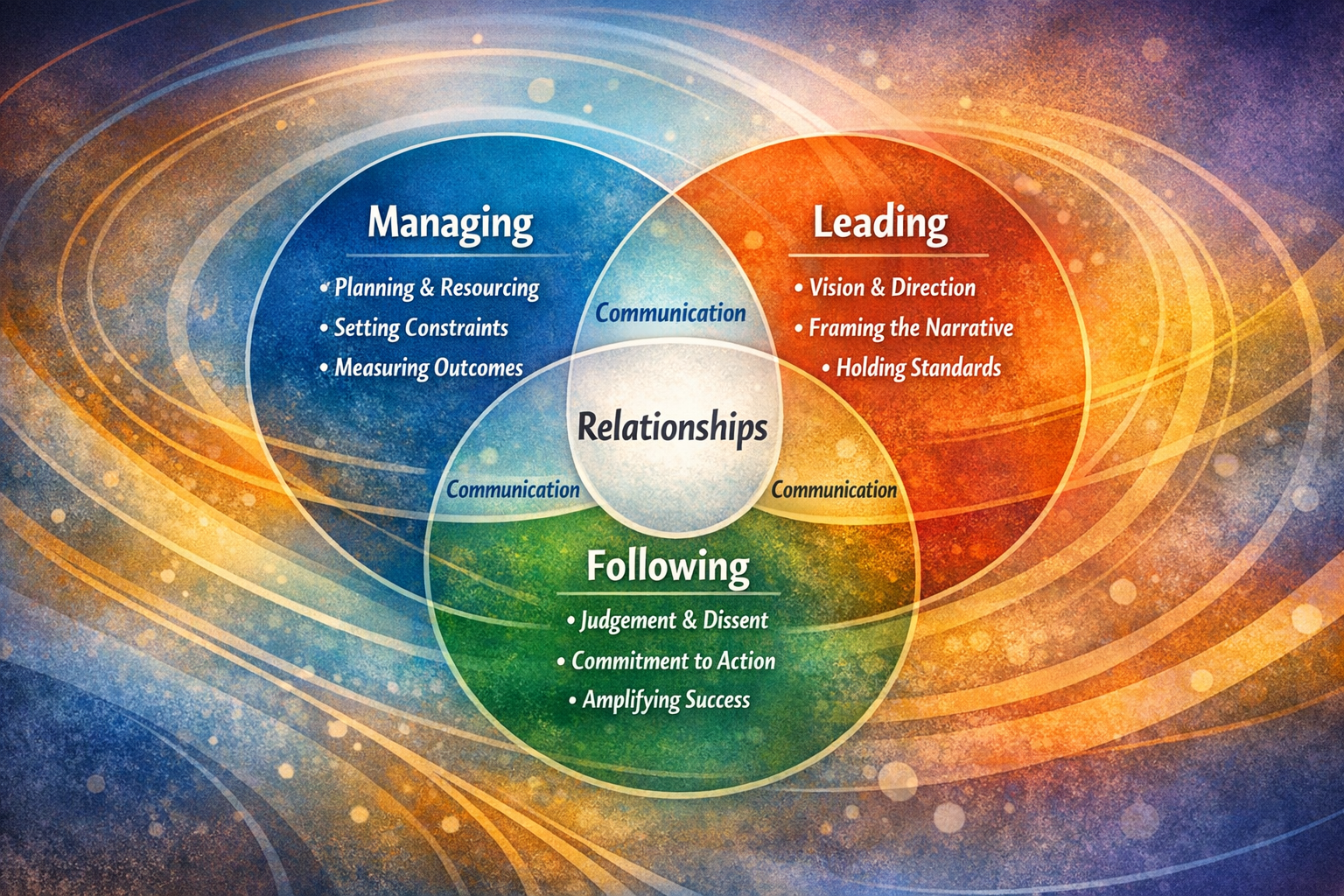
The path to leadership mastery is: Managing with clarity using systems, evidence gates and cadence. Leading with sensemaking, providing a vision, standards and psychological safety. Following with evidence based dissent and full commitment once decided and regular check-ins. The growth leader's hardest move may be to follow a subordinate, and yet often they are closest to the facts. Following is not abdication, it is deliberate delegation of authority inside guardrails, reversible tests, and escalation triggers.
Leadership is overvalued when it is reduced to decisiveness. The higher value is enabling high quality discussion under uncertainty. The path to mastery is: managing with clarity using gates and cadence; leading with sensemaking, providing standards and psychological safety; following with evidence based dissent and full commitment once decided and regular check-ins. The growth founder’s hardest move is to follow a subordinate, and yet often they are closest to the facts. Following is not abdication, it is deliberate delegation of authority inside guardrails, reversible tests, and escalation triggers. Done well, it upgrades relationships and makes the organisation less dependent on one person.
Leadership is often miscast as decisiveness, when its higher value is creating the conditions for good decisions. Sometimes it requires courage to pause and take time to reflect, and this may appear indecisive. However, it may be critical to gather data and create novel solutions.
Does it feel like we are in a bit of a leadership bubble? Leadership is overvalued when it is reduced to apparent decisiveness, populism and raised as more important than two other essential parts - managing and following. Your leadership is of little value without managing systems to effect it and followers to support it so good luck with the valuation you have for it. The higher value is enabling high quality discussion and decision making under uncertainty. with your teams, your partners and your systems. Therefore, the path to mastery is: Managing with clarity using systems, evidence gates and cadence. Leading with sensemaking, providing a vision, standards and psychological safety. Following with evidence based dissent and full commitment once decided and regular check-ins. The growth leader's hardest move may be to follow a subordinate, and yet often they are closest to the facts. Following is not abdication, it is deliberate delegation of authority inside guardrails, reversible tests, and escalation triggers. Done well, it upgrades relationships and makes the organisation less dependent on one person and allows us to LEAD with EASE.Who on your team will you be following today? How can you help them lead and manage?
Many workplaces, and society at large, rewards “decisive” leaders. However, what they really reward is emotional certainty in public, its short term reassurance and certainty. Under pressure and over time, that becomes a mask and the mask may feel imposter-ish. The price is high, truth slows down, risk travels late, and the organisation mistakes confidence for clarity until it fails. More decisiveness is then required in a crisis. Psychological safety is not softness, it is the social permission for reality to move to new places.
Many “leadership failures” are actually overlapping failures creating poor communication and brittle relationships.
"It doesn’t make sense to hire smart people and tell them what to do; we hire smart people so they can tell us what to do." Steve Jobs
The sharp personal edge is not always leading, it is choosing to follow, especially a smart and capable subordinate. When the best judgement is closer to the ground truth, your job is to loan leadership to the expert. That can be temporary, or it can be permanent, because the organisation matures beyond dependence on you. Research on followership supports the idea that strong followership enables healthier team dynamics and shared leadership.
Signals you should follow
What this requires emotionally is vulnerability, “I do not know yet”, paired with rigour, “Here is how we will find out, and by when.”
If you need better managing then look out for confusion, slippage, rework, busy teams, fuzzy outcomes. Install clarity, owners, gates, and a cadence.
If you need more leading then you may sense anxiety, avoidance, mixed priorities, softened reality. Run sensemaking, name trade offs, define principles, create psychological safety with standards.
If you need to be following then feel your private doubt, public compliance, expertise under used. Invite dissent early, then lock the decision and require commitment.
“I am choosing to follow you here because you are closest to the facts. I will back you publicly. We will debrief to learn, not to blame.”
Explore what is not being said, Align on decision rights and criteria, Support truth telling under pressure, Empower authority at the edge where speed lives. (coursecorrection.co.uk)
Suggested related read on coursecorrection.co.uk: Psychological Safety and Team Resilience, it reinforces the “truth must travel” principle behind this triad. (https://www.coursecorrection.co.uk/pillars/psychological-safety-and-team-resilience)
How do I follow a subordinate without losing authority? Set guardrails and decision rights, co-create the terms and back them publicly, then debrief outcomes and learning at a scheduled cadence. You know you have real authority when you can give it away and watch it grow. Remember who did that for you?
What if they make the wrong call? Did they make a bad call or get a bad result from a good call? It may just be the sights that need correcting, not the shooter. If it was within agreed constraints, treat it as data and understand that good intentions can have bad outcomes. Ask about the decision process, and identify what was right and what was uncertain. Tighten guardrails if necessary, improve tests, do not punish candour.
How do I stop discussion becoming endless debate? You can timebox sensemaking, define decision criteria upfront, appoint a decision owner, log the decision, then execute. Improve the conduct of meeting by defiing purpose and pre-meeting requirements. https://www.coursecorrection.co.uk/newsletters/how-can-we-have-better-meetings
How do I know if my culture is unsafe? This may be hard to see because it is being deliberately hidden from you, so why is that happening? You may get agreement in meetings, little or no dissent, side chats afterwards, late escalations, and repeated rework. Create better conditions for loyal dissent, dissent cards may help to elicit anonymous feedback about confidence. Ask the team why someone unnamed might feel like that?
Detert, J. R., & Burris, E. R. (2007). Leadership behavior and employee voice: Is the door really open? Academy of Management Journal, 50(4), 869–884.
Edmondson, A. C. (1999). Psychological safety and learning behavior in work teams. Administrative Science Quarterly, 44(2), 350–383.
Google. (n.d.). Understand team effectiveness. re:Work.
Kelley, R. E. (1992). The power of followership: How to create leaders people want to follow, and followers who lead themselves. Doubleday/Currency.
Kotter, J. P. (1990). What leaders really do. Harvard Business Review, 68(3), 103–111.
Morrison, E. W. (2011). Employee voice behavior: Integration and directions for future research. The Academy of Management Annals, 5(1), 373–412.
Nembhard, I. M., & Edmondson, A. C. (2006). Making it safe: The effects of leader inclusiveness and professional status on psychological safety and improvement efforts in health care teams. Journal of Organizational Behavior, 27, 941–966.
Uhl-Bien, M., Riggio, R. E., Lowe, K. B., & Carsten, M. K. (2014). Followership theory: A review and research agenda. The Leadership Quarterly, 25(1), 83–104.