© 2024–2026 Course Correction Consulting Ltd. All rights reserved. LEAD with EASE™ for Organisational Judgement is James Hardie’s distinctive double mnemonic and applied model, developed in April 2025 and first published on 23 July 2025.
.svg)
.svg)


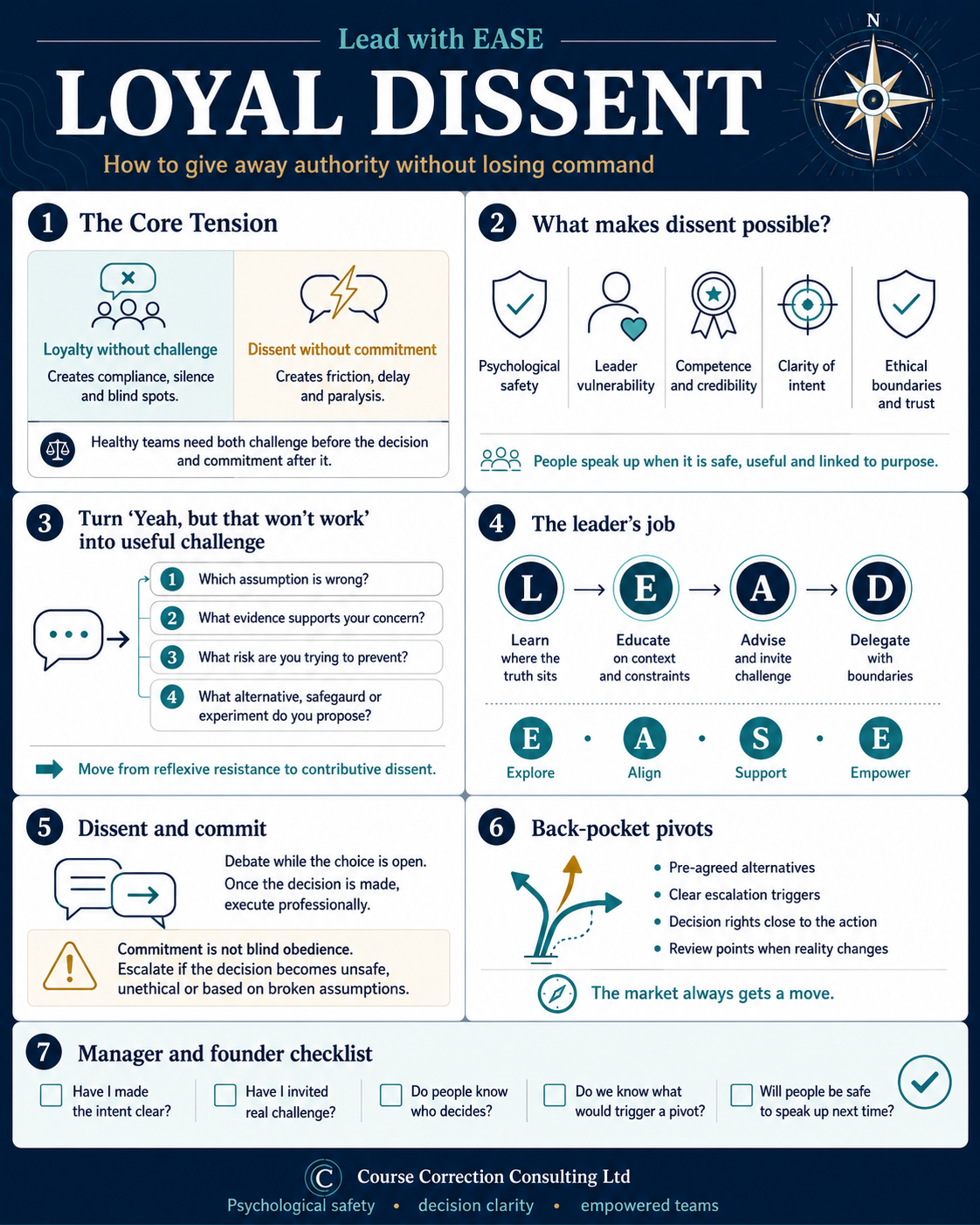
Loyal dissent helps founders and managers build psychologically safe teams that challenge before decisions, commit after them and pivot when reality changes.Loyalty without challenge creates silence. Dissent without commitment creates paralysis. This article explains how founders and managers can use loyal dissent, decision clarity and back-pocket pivots to build teams that challenge well, commit clearly and adapt with confidence.
Loyalty without challenge produces compliance. Dissent without commitment produces paralysis. Effective leaders create a disciplined space between the two. They clarify intent, invite genuine challenge, decide transparently and empower people to adapt when reality changes. Psychological safety matters, but so do competence, accountability and ethical boundaries. International culture, organisational status and gender stereotypes influence who can disagree safely and whose dissent is believed. The answer is not endless debate or reflexive negativity. It is loyal dissent followed by informed commitment, supported by predetermined pivot points. Authority is not weakened when discretion is distributed intelligently. It is weakened when people cannot distinguish between purpose, plan and personal preference.
Loyal Dissent is a Strength beyond Compare. Strong leaders protect authority by making constructive dissent expected before a decision, commitment clear afterwards, and adaptation legitimate when assumptions change.
• Establish strategic intent, ethical boundaries and decision rights before delegating authority.
• Invite evidence based challenge while choices remain genuinely open.
• Convert objections into risks, assumptions, alternatives or experiments.
• Commit to the chosen course, while agreeing the evidence that would justify a pivot.
Loyal dissent: constructive challenge offered in service of the shared purpose rather than personal position.
In a study of 3,149 employees and 223 managers, managerial openness was more consistently associated with employee voice than transformational leadership
“Mastering the Art of Course Correction” is not about producing a perfect plan. It is about building the judgement, trust and authority to challenge a plan before it fails, commit once a choice is made, and change course when reality provides new evidence.
Our political discourse frequently presents loyalty and dissent as opposites. Loyalty becomes personal allegiance. Dissent becomes betrayal. Leaders are encouraged to value people according to how enthusiastically they confirm the prevailing view.
Businesses have a choice. They can reproduce that dynamic, or create something more intelligent.
A mature organisation needs people who are loyal enough to challenge it.
The first question is not whether somebody is loyal. It is what they are loyal to.
Loyalty to a founder, senior leader or dominant group can create cohesion, but it can also corrupt judgement. Ethical organisational loyalty must attach itself to something beyond the individual:
• the purpose of the organisation
• its lawful and ethical obligations
• customers, colleagues and affected communities
• professional standards
• the long term viability of the enterprise
This distinction matters because a leader’s preferred plan and the organisation’s best interests are not always the same thing.
Loyal dissent is therefore not opposition to authority. It is the responsible use of judgement in support of the mission.
Employee voice research defines voice as the discretionary communication of ideas, concerns or information intended to improve organisational functioning. The uncomfortable finding is that employees routinely withhold relevant information, often because they doubt that speaking will be safe or useful.
Silence should not be mistaken for agreement. It may indicate fear, futility, exhaustion, cultural deference or the entirely rational conclusion that the decision has already been made.
Research associated with Charlan Nemeth suggests that minority dissent can stimulate divergent thinking. Majority agreement tends to focus attention on the prevailing position, while exposure to a competing view encourages people to examine additional perspectives and possible solutions.
That does not mean every objection is insightful.
Some dissent is principled. Some is politically motivated. Some reflects expertise. Some reflects fear of change. Some is simply an automatic response:
“Yeah, but that will not work.”
This statement sounds analytical but frequently contains no analysis. It rejects responsibility while preserving the speaker’s ability to say later that they predicted failure.
Leaders should neither suppress such comments nor allow them to become cost free vetoes.
A useful response is:
This moves the discussion from reflexive resistance to contributive dissent.
However, leaders should be cautious about insisting that nobody may raise a problem without presenting a complete solution. That rule can silence precisely the people who first notice a safety, ethical or operational threat. A credible concern deserves attention even when the person raising it cannot resolve it alone.
The better standard is:
Bring evidence, a risk, an alternative, a test, or a question that improves the decision.
Amy Edmondson defines psychological safety as a shared belief that a team is safe for interpersonal risk taking. Her research connected it with learning behaviours such as asking for help, discussing errors and experimenting with improvements.
Psychological safety does not mean that every opinion is accepted, every challenge succeeds or accountability disappears. It makes candour possible. It does not make judgement unnecessary.
Dissent becomes more likely when five conditions are present.
A leader who claims certainty leaves little intellectual room for anybody else.
Useful vulnerability is not theatrical self doubt. It is the disciplined acknowledgement that:
• the information is incomplete
• assumptions may be wrong
• other people may see something the leader cannot
• the external environment remains capable of surprise
The leader might say:
“This is my current judgement. Here are the assumptions supporting it. Tell me what I may have missed.”
That invitation must be credible. If the first challenge produces irritation, interruption or later exclusion, the invitation will not be trusted again.
Authority cannot responsibly be distributed merely because empowerment sounds desirable.
Mission command depends upon preparation, shared understanding and capable people. United States Army doctrine identifies competence, mutual trust, shared understanding, clear intent, mission orders, disciplined initiative and risk acceptance as mutually reinforcing principles.
Competence gives dissent credibility. It also enables people to distinguish between:
• an uncomfortable decision and an unsafe decision
• a calculated risk and an unmanaged hazard
• a strategic constraint and a leader’s personal preference
• a genuine change in circumstances and ordinary implementation difficulty
Leaders who want initiative must invest in the education, rehearsal and contextual understanding that make initiative useful.
People cannot adapt intelligently if they know only what they have been told to do.
They must also understand:
• why it matters
• what outcome is required
• which constraints are genuine
• what must be protected
• what can be traded
• what success and failure look like
British Army doctrine distinguishes intent from detailed execution. It emphasises communicating what must be achieved and why, allowing subordinates to understand the context and recommend refinements through backbriefing. It also recognises the value of contingency plans, branch plans, red teaming and war gaming.
This is not merely military language applied decoratively to business. It addresses a common organisational failure: people follow the original instructions after the conditions that justified those instructions have disappeared.
Empowerment becomes dangerous when strategy has not reduced ambiguity.
A team cannot make coherent tactical pivots if every customer, priority, product, value and opportunity is supposedly equally important.
Prior strategic choices establish the landscape within which initiative can occur:
• which customers matter most
• what value the organisation intends to create
• which capabilities deserve protection
• which risks are acceptable
• what the organisation will not do
• where scarce resources will be concentrated
Without these choices, delegation is not empowerment. It is the transfer of confusion.
Leader inclusiveness consists of words and actions that invite and appreciate other people’s contributions. Research in multidisciplinary healthcare teams found that inclusive leadership helped reduce the silencing effects associated with professional status differences.
The leader does not have to agree. They do have to demonstrate that the contribution was heard, examined and answered.
A useful decision record might state:
• the decision
• the alternatives considered
• the principal objections
• the assumptions relied upon
• the decision owner
• the review date
• the evidence that would trigger reconsideration
This makes commitment more legitimate because people can see that the process was real.
Toyota’s andon system allows an operator to signal an abnormality and call for help, with production capable of being stopped where necessary to prevent defects progressing through the system.
The important principle is not the cord itself.
Toyota designed dissent into the work.
The employee does not have to summon unusual courage, arrange a meeting with a senior executive or construct a political coalition. The system gives them:
• a recognised signal
• permission to use it
• a rapid response
• a structured investigation
• protection from being treated as the problem
Many organisations tell employees to speak up but provide no equivalent mechanism. They depend upon individual bravery to compensate for weak system design.
That is not psychological safety. It is organisational gambling.
Pixar’s Braintrust approach brought experienced colleagues together to identify weaknesses in work under development. The group could challenge the work candidly, but responsibility remained with the film’s director rather than transferring to the critics.
This separation is powerful.
Dissent provides information. It does not automatically acquire authority.
The decision owner remains accountable for integrating the advice, making trade offs and proceeding. This prevents two common failures:
Healthy dissent needs both voice and ownership.
Amazon formally expects leaders to challenge decisions respectfully and then commit once a decision has been made.
The principle addresses a real problem. Organisations cannot reopen every decision whenever somebody remains dissatisfied. Endless consultation can become a sophisticated form of avoidance.
Yet “disagree and commit” contains an ethical vulnerability.
It can be used by powerful leaders to declare debate over before weaker participants have been heard. Commitment then becomes a euphemism for compliance.
The principle is legitimate only when:
• the opportunity to dissent was genuine
• relevant information was considered
• the decision maker is identifiable
• reasons are communicated
• no unlawful, unsafe or unethical conduct is required
• new material evidence can reopen the decision
Commitment should close the argument temporarily. It should not close the organisation’s eyes.
The United States House Committee investigation into the Boeing 737 MAX identified flawed assumptions, technical failures, production pressures and missed opportunities to change direction. The two accidents killed 346 people.
An internal survey cited in the report found that 39 per cent of Boeing authorised representatives surveyed believed they had experienced undue influence. The report also described safety and quality warnings raised by plant supervisor Ed Pierson while production continued to increase.
The lesson is not that nobody spoke.
People did speak.
The deeper failure was that warnings competed against schedule, production, hierarchy and organisational self protection.
A formal reporting channel is not sufficient if employees believe that:
• confidentiality will not hold
• career consequences will follow
• the issue will disappear into procedure
• production priorities will prevail
• the messenger will be examined more closely than the message
Ethical leadership requires more than inviting dissent. It requires creating organisational consequences for ignoring credible warnings.
Before the Battle of Midway, Commander Joseph Rochefort’s intelligence assessment conflicted with views elsewhere in the United States naval intelligence system. Admiral Chester Nimitz allowed the competing interpretation to be tested and used the resulting intelligence to shape his decision.
A decision forcing case asks participants to inhabit the position of a historical decision maker before learning the outcome, then explain and defend what they would do.
Consider the position:
• Your specialist team holds a minority assessment.
• Other authorities disagree.
• Time is short.
• The cost of error is severe.
• Certainty is unavailable.
What evidence would change your decision?
How would you test the contested assumption?
Would status or proximity influence whose analysis you trusted?
The lesson is not simply “listen to experts”. Experts disagree. The leadership task is to make disagreement examinable.
During planning for Operation Market Garden, intelligence officer Brian Urquhart became increasingly concerned about German resistance and the assumptions supporting the operation. In his later account, he described an atmosphere in which optimism about ending the war reduced serious consideration of opposition.
The decision forcing question is uncomfortable:
When does perseverance become motivated blindness?
Imagine that the organisation has already committed prestige, resources and senior sponsorship to a plan. New intelligence threatens the narrative.
Do you:
• proceed because delay carries strategic costs
• modify the plan
• commission further reconnaissance
• define a threshold for cancellation
• remove the dissenter because they are damaging confidence
This is where ethics, identity and sunk costs collide. Leaders may interpret challenge as disloyalty because abandoning the plan would also require them to revise their opinion of themselves.
On D-Day, the 1st Battalion Hampshire Regiment landed in the wrong place, lost senior leaders, suffered communications failures and encountered stronger resistance than expected. Nevertheless, it achieved most of its first day objectives. The case has been used to illustrate how prior training, simple intent, subordinate development and mission command can enable adaptation when the original plan collapses.
The crucial leadership work happened before the crisis.
People had been prepared to act without waiting for the person normally authorised to decide.
This is the essence of a back pocket pivot. It is not improvisation without boundaries. It is a pre authorised response to foreseeable disruption.
In business, back pocket pivots might include:
• alternative suppliers
• minimum acceptable service configurations
• pre agreed spending limits
• customer recovery options
• degraded operating modes
• escalation triggers
• authority to pause unsafe or unethical activity
The market, competitor, regulator, customer and technology all get a move. None attended your planning meeting.
International leaders should resist simplistic national stereotypes. Culture does not determine individual behaviour, and variation within countries can be greater than variation between them.
However, cultural expectations concerning hierarchy, face, harmony and authority can affect whether dissent is expressed directly, indirectly or not at all. Research has associated stronger power distance beliefs with less effective upward workplace communication, while cross cultural voice research shows that employees interpret organisational signals about whether speaking is safe and likely to matter.
A British leader may interpret silence as consent.
A colleague from a more hierarchical context may believe that publicly contradicting the leader would be disrespectful, irresponsible or professionally dangerous.
The solution is not to demand that everybody imitate one culturally preferred communication style. It is to provide several legitimate routes for challenge:
• discussion before the meeting
• written evidence
• anonymous reporting
• one to one review
• structured red teaming
• rotating devil’s advocacy
• explicit invitation from the decision owner
• private escalation for ethical or safety issues
The standard should be common, but the channel need not be identical.
Dissent is not evaluated independently of the person delivering it.
Research by Victoria Brescoll found that greater power increased speaking time for men but not women. Her experiments also indicated that highly talkative women could be evaluated more negatively, while greater volubility benefited perceptions of powerful men.
Related research on backlash shows that women displaying agentic behaviour may face penalties for violating expectations of warmth or deference.
This creates a double bind:
• speak firmly and risk being judged abrasive
• soften the message and risk being ignored
• remain silent and risk being considered insufficiently strategic
Telling women simply to become more confident does not solve a structurally unequal evaluation process.
Leaders should examine:
• who is interrupted
• whose idea receives recognition
• whether the same behaviour is described differently across genders
• who is expected to soften difficult messages
• whether dissenters are labelled emotional, aggressive, difficult or disloyal
• who is invited to speak after the senior leader has expressed a view
Equality of invitation is not enough. Leaders must examine equality of reception.
There are ethical and moral limits to “dissent and commit”.
No employee should be expected to commit to conduct that they reasonably believe is unlawful, deliberately deceptive, discriminatory or unsafe. Professional duties may require continued escalation even after a senior decision has been made.
A mature commitment rule is therefore:
Commit to execution while the decision remains lawful, ethical and supported by its material assumptions. Escalate when those conditions cease to hold.
New evidence is not disloyalty.
A changed environment is not insubordination.
A safety concern does not expire because the meeting ended.
Telling people it is safe to dissent is not the same as people demonstrating dissent safely and with support.
Leaders anxious about giving authority away often attempt to maintain control through detailed instructions. This feels safer but creates decision dependency. Every unexpected situation returns to the leader for interpretation, especially if the leader is the easiest route toa shortcut around any established principles and procedures.
A better approach is to LEAD with EASE and consistently too.
Learn where information actually exists. Learn to value the transactive memory capacity of your organisation, knowing who knows what and who knows who? (Wegner) These may be your M-Shaped Orchestrators of effect.
Ask who is closest to the customer, process, risk or emerging technology. Examine previous decisions without converting the review into blame.
Consider tools which can analyse the digital connections and the other relationships in your organisation.
Educate people about purpose, context, constraints and strategic choices. Acquire new skills or people with required skills.
Do not distribute tasks while retaining all the meaning for yourself, make purpose part of every ask. Int his way intrinsic motivation is enhanced and outcomes become more visible beyond mere outputs.
Create a period in which advice, challenge and alternatives are actively sought. Use psychological hacks like the Premortem or Miracle Question to break down any barriers to discourse and dialogue
Separate disagreement about the decision from disrespect towards the decision maker, who cashould be making a decision with the best information available.
Delegate decisions with explicit boundaries, resources and escalation conditions.
Apparent authority without resources is theatre. Authority without accountability is abandonment.
Ownership makes for better decisions, not justifications for others to make decisions.
Surface assumptions, uncertainties, stakeholder interests and early warning signs.
Ask: What would have to be true for this plan to succeed?
Ask: WHat would change my mind about this decision.
Agree the intent, ethical boundaries, decision owner, priorities and measures of success.
Clarify what may change and what must remain protected.
Develop competence, psychological safety, access to information and reliable escalation routes.
Respond constructively when somebody pulls the organisational red cord.
Understand the boundaries that may be in play of economic, performance and workload factors (Rasmussen)
Permit disciplined initiative, within guided boundaries. Update processes to deal with the differences between work as imagined and work as done
Give people authority to execute, adapt or pause within agreed limits. Review their judgement afterwards to improve the system, not merely to identify fault.
Your leadership will be enhanced when you establish a simple pledge to unlock loyal dissent within your team.
The leader promises to:
• explain the intent and constraints
• expose important assumptions
• invite relevant challenge
• protect respectful dissent
• decide clearly
The team promises to:
• raise material concerns early
• distinguish evidence from preference, objective and subjective
• offer alternatives or tests where possible
• challenge the issue rather than the person
• avoid passive resistance
Everybody agrees to:
• support execution professionally
• avoid covert sabotage or retrospective point scoring
• monitor agreed assumptions
• report material changes promptly
• pivot when predetermined triggers are reached
• review outcomes honestly
This is not mere consensus.
It is disciplined plurality followed by coordinated action.
It is up to you all to be honest about how this works, or does not.
The strongest evidence of leadership is not that the team obeys while the leader is present.
It is that people can make good decisions when the leader is absent, the plan is failing, resources are scarce and the situation no longer resembles the briefing.
Authority is not weakened when it is shared intelligently.
It is weakened when the leader becomes the only person permitted to interpret reality.
For further reading, see Leadership vs Management vs Followership: What’s the Difference, and Why Does It Matter?, particularly its argument for evidence based dissent, clear systems and the willingness of leaders to follow those closest to the facts.
The practical foundations are also explored in What Can I Do to Improve Leadership?, including psychological safety, ownership and the conditions required for people to lead differently.
Clarify who decides, what the decision must achieve and which boundaries cannot be crossed. Dissent improves the information available to authority; it does not remove accountability from the decision owner.
Require them to identify the contested assumption, material risk or evidence behind their objection. Persistent negativity without contribution is a performance issue, but persistent challenge may also reveal repeatedly poor decision processes.
Debate should end when the decision owner has sufficient information to act within the available time and risk. Record what would justify reopening the decision so that commitment does not become rigidity.
Poorly structured debate can consume time, intensify interpersonal conflict and obscure accountability. Psychological safety must be combined with standards, competence, decision discipline and clear behavioural expectations.
Do not ask only whether people feel safe. Examine behaviour: who challenges senior leaders, what happens afterwards, whose warnings receive action, and whether inconvenient information reaches decisions before failure.
Detert, J. R., & Burris, E. R. (2007). Leadership behaviour and employee voice: Is the door really open? Academy of Management Journal, 50(4), 869–884. https://doi.org/10.5465/amj.2007.26279183
Edmondson, A. C. (1999). Psychological safety and learning behaviour in work teams. Administrative Science Quarterly, 44(2), 350–383. https://doi.org/10.2307/2666999
Morrison, E. W. (2014). Employee voice and silence. Annual Review of Organizational Psychology and Organizational Behavior, 1, 173–197. https://doi.org/10.1146/annurev-orgpsych-031413-091328
Nembhard, I. M., & Edmondson, A. C. (2006). Making it safe: The effects of leader inclusiveness and professional status on psychological safety and improvement efforts in healthcare teams. Journal of Organizational Behavior, 27(7), 941–966. https://doi.org/10.1002/job.413
Nemeth, C. J., & Kwan, J. L. (1987). Minority influence, divergent thinking and detection of correct solutions. Journal of Applied Social Psychology, 17(9), 788–799. https://doi.org/10.1111/j.1559-1816.1987.tb00339.x
Brescoll, V. L. (2011). Who takes the floor and why: Gender, power and volubility in organisations. Administrative Science Quarterly, 56(4), 622–641. https://doi.org/10.1177/0001839212439994
Dai, Y., Li, H., Xie, W., & Deng, T. (2022). Power distance belief and workplace communication: The mediating role of fear of authority. International Journal of Environmental Research and Public Health, 19(5), Article 2932. https://doi.org/10.3390/ijerph19052932
Kwon, B., & Farndale, E. (2020). Employee voice viewed through a cross-cultural lens. Human Resource Management Review, 30(1), Article 100653. https://doi.org/10.1016/j.hrmr.2018.06.002
Rudman, L. A., Moss-Racusin, C. A., Phelan, J. E., & Nauts, S. (2012). Status incongruity and backlash effects: Defending the gender hierarchy motivates prejudice against female leaders. Journal of Experimental Social Psychology, 48(1), 165–179. https://doi.org/10.1016/j.jesp.2011.10.008
Amazon. (n.d.). Leadership principles: Have backbone; disagree and commit. https://www.amazon.jobs/content/en/our-workplace/leadership-principles
Catmull, E. (2008). How Pixar fosters collective creativity. Harvard Business Review, 86(9), 64–72.
Toyota Motor Europe. (n.d.). Toyota Production System. https://www.toyota-europe.com/about-us/toyota-vision-and-philosophy/toyota-production-system
U.S. House of Representatives, Committee on Transportation and Infrastructure. (2020). The design, development and certification of the Boeing 737 MAX. U.S. Government Publishing Office. https://www.govinfo.gov/app/details/GOVPUB-Y4_T68_2-PURL-gpo144993
Canadian Army. (2021, September 21). Decision-forcing cases. Government of Canada. https://www.canada.ca/en/army/services/line-sight/articles/2021/09/decision-forcing-cases.html
Development, Concepts and Doctrine Centre. (2022). UK defence doctrine (6th ed., Joint Doctrine Publication 0-01). Ministry of Defence.
Ministry of Defence. (2016). Army doctrine publication: Land operations. British Army.
Naval History and Heritage Command. (2017). H-Gram 006: Battle of Midway 75th anniversary. United States Navy.
Tolman, M. S. F. N. (2020). Mission command: A senior enlisted leader’s perspective. NCO Journal. Army University Press.
Townsend, S. J., Crissman, D. T., McCoy, K., & Mingus, J. (2019). Reinvigorating the Army’s approach to command and control. Military Review, 99(4), 4–9.
Urquhart, B. (1987, September 24). The last disaster of the war. The New York Review of Books.
Wright, D. P. (Ed.). (2013). Sixteen cases of mission command. Combat Studies Institute Press.