© 2024–2026 Course Correction Consulting Ltd. All rights reserved. LEAD with EASE™ for Organisational Judgement is James Hardie’s distinctive double mnemonic and applied model, developed in April 2025 and first published on 23 July 2025.
.svg)
.svg)


How can we: Recognise patterns, then slow judgement long enough to test your story? Utilise existing patterns, buy the commodity, keep your differentiation? Create new patterns only where the domain is genuinely complex?
Founders lose their ease when they forget that leadership is pattern work. Firstly, recognise patterns, but slow judgement enough to avoid mislabelling people, especially under pressure. Kahneman explains how fast thinking is powerful and biased, so use behavioural evidence, base rates, and disconfirming questions to be critical. Secondly, properly utilise patterns by buying or outsourcing what is commoditised, and protect what differentiates you. Wardley Maps help separate commodity from novel work. Thirdly, create new patterns where reality is complex, co-create for diverse perspectives, using Cynefin Frameworks to choose the right decision logic. In complexity, run safe to fail probes and learn fast. Make these three moves a weekly rhythm, not a founder instinct.
Humans are great at creating and recognising patterns. The “lost answer” in most growing businesses is that ease comes from mastering patterns, not from working harder.
Recognise patterns, then slow judgement long enough to test your story.
Utilise existing patterns, buy the commodity, keep your differentiation.
Create new patterns only where the domain is genuinely complex.
Ritualise all three as a team habit, not a founder instinct.
Definition: Pattern literacy is the ability to notice repeats, reuse proven solutions, and invent safely when reality is new.
Data point: Snowden & Boone’s Cynefin paper has been cited 4,700+ times, a signal of how widely this decision logic travels across sectors.
Early on, founders are close to customers and reality. Decisions are fast, feedback is immediate, and patterns are obvious. Then the business grows. Distance increases. Meetings multiply. Context fragments. The founder starts interpreting noise as signal, and treats every problem as unique. That is where “leading with ease” quietly dies.
The fix is a return to pattern literacy, split into three moves: Recognition, Utilisation, and Creation.
Humans are exceptional pattern matchers. Under pressure, we default to fast judgement and create coherent stories quickly, even when the data is thin, we create short cuts and use subconscious capabilities to move fast. Kahneman frames this as System 1 and System 2, fast intuition versus slow deliberation, and sometimes this benefit can betray us.
"The one type of judgement we all do really well is mis-judgement." James Hardie
Misjudgment and Where founders can go wrong
Trust and verify
Practical moves
The BEAR mnemonic is a structured approach to providing feedback, particularly in correction contexts. It stands for: Behaviour: Describe the specific behaviour observed; Effect: Explain the impact of that behaviour on the team or organisation; Alternative: Suggest a behaviour that should replace the current one; Result: Outline the desired outcome or result after the suggested change.
EASE link Explore is the discipline of seeing reality before you defend a story.
Most operational effort should be boring. If everything feels bespoke, you are likely burning time on commodity work.
Wardley Mapping is useful because it forces a clean separation between what is novel and differentiating versus what is mature and commoditised, moving from Genesis to Commodity.
Where founders and you may be going wrong
Practical moves
EASE link Align is where mapping becomes roles, boundaries, and language the whole team can use.
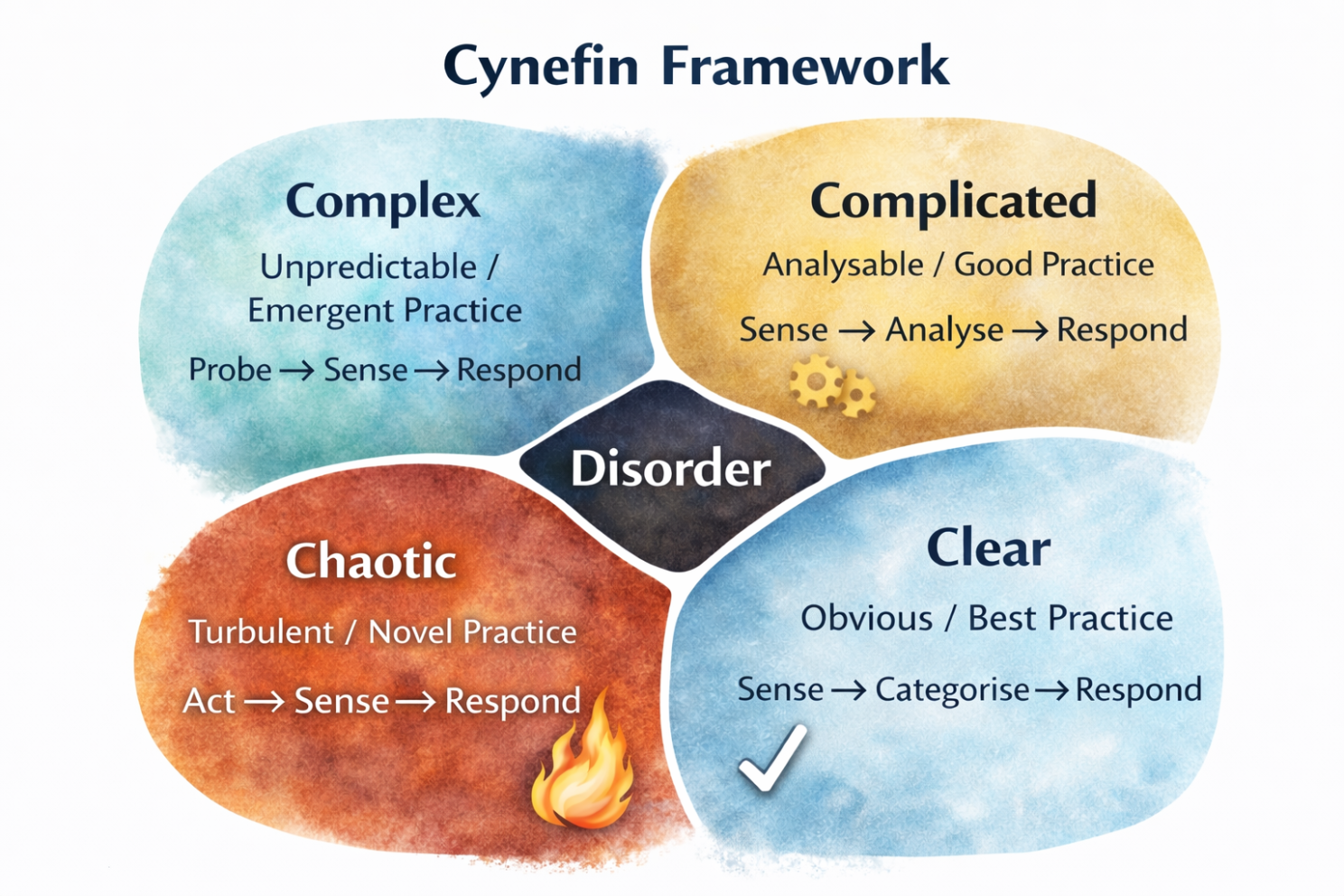
Some problems are not solvable by analysis first because the act of intervening changes the system. This is Cynefin territory.
Snowden and Boone distinguish clear, complicated, complex, chaotic, with different decision logics. In complexity, the move is probe, sense, respond, not “analyse, decide, roll out”, thi sis the realm of experts and yet still the answer is not certain. Expertise understand what they know and what they do not know, and what may need to be created.
Where you may be going wrong
Complex and Complicated are different, but perhaps most likely to be misdiagnosed.
Practical moves
LEAD with EASE, recognising support is psychological safety plus learning cadence, Empower is bounded authority at the edge where information lives.
If you want EASE, you need a weekly rhythm that protects these three moves:
This is also where March’s exploration and exploitation trade off becomes practical, exploit relentlessly what is known (hit the button), explore where the world is genuinely uncertain.
Remember: The Map is not the terrain
Frameworks can become their own form of theatre. The map is not the terrain, a strategy is not certain and plans may become useless. Complexity can be used as an excuse for indecision.
Your job is classification discipline, then action discipline. If everything is complex, which it is not, you are either avoiding standards, or you have not reduced the problem to its parts.
Wardley Maps can help identify what and how to integrate: Genesis, Custom built, Product, Commodity OR Create, Build, Borrow or Buy.