
There is a sentence I would be very cautious about using after acquiring a company: “Nothing is going to change.” It is usually intended kindly and may even be sincerely believed. New owners want to reassure employees, prevent customers becoming nervous and stop valuable people interpreting uncertainty as a reason to answer the next call from a recruiter. Management wants everyone concentrating on the business rather than speculating about what happens next. Nobody necessarily intends to destroy the culture, replace the management team or dismantle the things that made the company attractive in the first place. Yet the promise contains a problem. An acquisition has already changed something fundamental: ownership, expectations and the distribution of power. Even before a single process is altered, people know that the future is no longer quite the same.
Then the practical work of ownership begins. Finance wants reporting aligned with the group. IT wants compatible systems. HR discovers different employment policies. Procurement identifies suppliers that could be consolidated. The board wants better visibility. Investors quite reasonably want performance measured against the value-creation plan. Managers discover duplicated responsibilities. Two ambitious executives appear to own broadly the same territory. Marketing wants a coherent identity and operations sees opportunities for standardisation. None of these things is inherently unreasonable. Many may be essential to achieving the purpose of the acquisition. Yet six months later an employee can look around and conclude, with some justification, that almost everything has changed.
Perhaps both perspectives are true.
Organisations experience change cumulatively
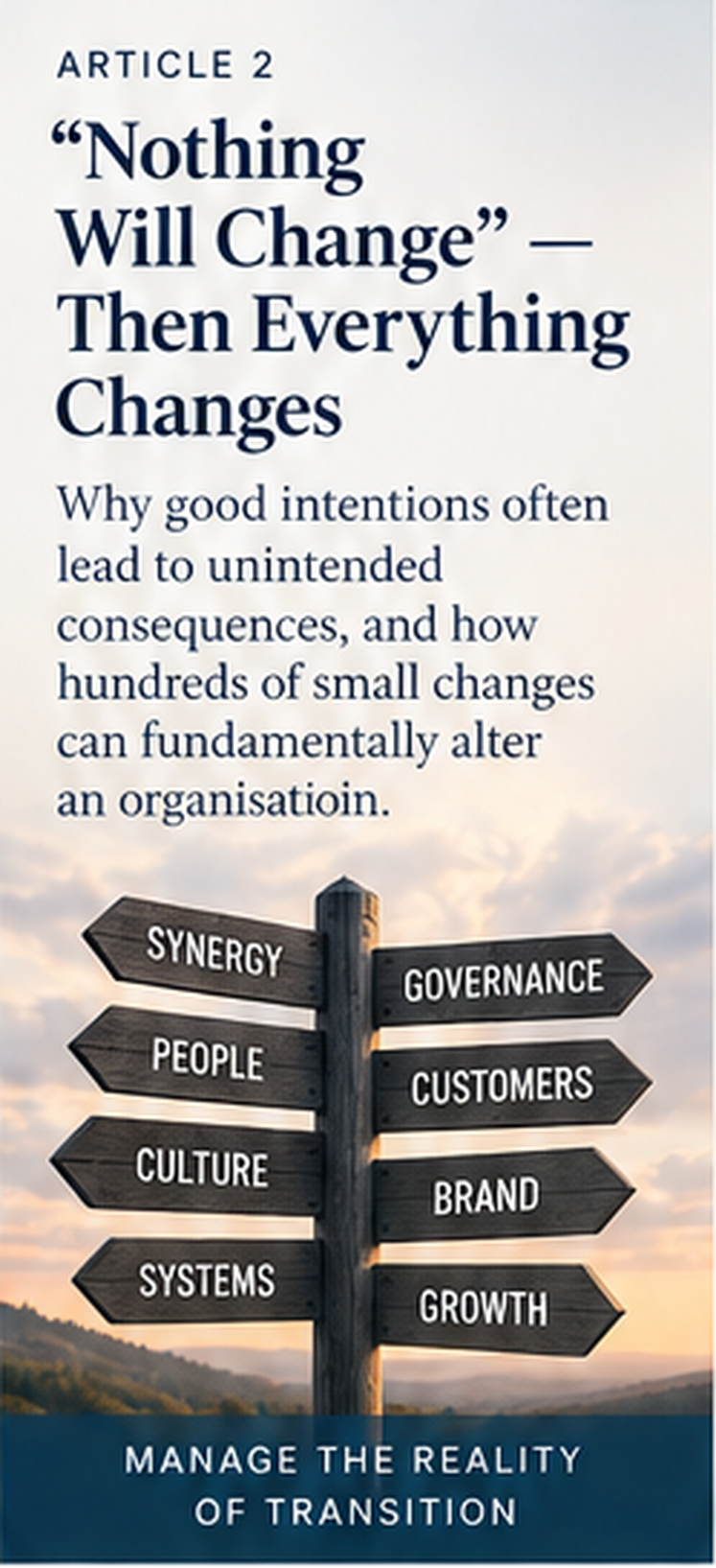
This is one reason I think we should be careful with the conventional language of integration. From the boardroom, an acquisition can appear as a portfolio of manageable workstreams: finance integration, technology integration, people integration, brand integration, commercial integration, governance and operations. Each can have an accountable owner, milestones, expected benefits and a perfectly sensible business case. Programme management encourages us to break complexity into manageable components, and there is good reason for doing so. The difficulty is that employees and customers do not experience an organisation as a collection of independent workstreams. They experience the combined system.
A new expense policy, for example, is not merely a finance change if it alters managerial discretion. A new CRM is not merely a technology implementation if it changes how customer relationships are managed. A revised reporting line may look like a small adjustment to an organisation chart while representing a substantial loss of status or autonomy to the person affected. Consolidating suppliers may produce genuine savings while unintentionally removing a relationship containing years of tacit operational knowledge. Even stopping an apparently unnecessary weekly meeting can matter if nobody realised that it was one of the few places where weak signals travelled between departments.
This is not an argument against standardisation, consolidation or integration. Acquirers sometimes inherit duplicated systems, poor controls, inefficient processes and practices that survive largely because nobody has challenged them. The danger lies elsewhere: every individual decision can be rational while their cumulative organisational effect is not. Integration programmes therefore need some mechanism for seeing across workstreams rather than assuming that optimisation within each workstream will necessarily optimise the organisation as a whole.
The psychological contract is not the employment contract
Organisational psychology provides a useful concept for understanding why apparently modest changes can generate surprisingly strong reactions: the psychological contract. Unlike the formal employment contract, it concerns the beliefs people develop about the reciprocal obligations between themselves and their organisation. Some expectations are created explicitly, while others emerge through repeated experience. An employee may come to believe that expertise will be respected, good performance will lead to opportunity, managers will listen before making consequential decisions, or that a degree of autonomy is part of what the organisation offers in return for commitment.
Research on psychological contracts during organisational change suggests that perceptions of organisational support, participation, communication and fairness influence whether employees interpret change as consistent with, or a breach of, that relationship. The concept should not be stretched too far. Organisations cannot reasonably preserve every expectation an employee has accumulated, and some expectations may never have been promised at all. Acquisition also creates legitimate reasons to renegotiate how work is done. Nevertheless, psychological-contract research helps explain something that financial models struggle to capture: people react not only to what changes, but also to what they believe the change means about their relationship with the organisation.
An approval threshold may therefore be experienced as more than a control mechanism. To senior leadership it may represent sensible governance; to an experienced manager it may signal that their judgement is no longer trusted. A common group process may look like sensible harmonisation to the acquirer while appearing to the acquired team as evidence that its experience is being disregarded. Neither interpretation has to be completely correct for it to influence behaviour. Organisational judgement requires leaders to understand both the intended effect of a decision and the interpretations that decision is likely to produce.
“Who are we now?”
There is another layer to this. Organisations are not simply structures for coordinating economic activity; they also become sources of social identity. People describe themselves as belonging to a company, profession, location, team or specialist community. They learn its language, accumulate stories and develop shared assumptions about what constitutes good work. They know which customers matter, which behaviours earn respect and which stories make sense only to somebody who has spent several years inside the organisation.
Research applying social identity theory to mergers and acquisitions has explored how post-merger identification can be affected by continuity, relative status, fairness and leadership. This is important because an acquisition can alter the answer to a deceptively simple question: Who are we now? Employees from a successful acquired company may find themselves described as the smaller partner even though they previously regarded their organisation with considerable pride. People in the acquiring business may meanwhile wonder why newcomers are receiving investment, senior positions or executive attention. The psychological disruption therefore does not belong solely to the acquired company.
Identity can sound like a soft consideration until it starts influencing behaviour. People decide whether to stay, whether to share knowledge, whether to trust unfamiliar colleagues and whether to invest discretionary effort in making the new organisation work. They also interpret the competence of the new leadership through what happens around them. When an acquirer changes something employees believe was central to previous success, resistance may reflect defensiveness or attachment to the past. But it may also contain information. The people resisting may understand something about the business that the integration team has not yet learned.
That distinction matters. Not every complaint is wisdom, but neither is every objection resistance to change.
Fairness matters even when outcomes cannot be equal
An acquisition will almost inevitably create winners and losers. There may be two finance directors and eventually only one role. One organisation's systems may survive while another's disappear. Some offices may close. Managers gain or lose responsibility. Budgets move and career paths change. Trying to persuade everybody that these outcomes are equally beneficial is unlikely to build credibility because they plainly are not.
Organisational justice research offers a more useful perspective. A substantial meta-analytic literature distinguishes between distributive justice, concerned with the fairness of outcomes; procedural justice, concerned with how decisions are made; and interactional justice, concerned with how people are treated and informed. These dimensions have been associated with outcomes including trust, commitment, satisfaction and organisational behaviour. M&A-specific research similarly suggests that perceived fairness during integration matters for employee attitudes and identification.
This does not mean that a sufficiently elegant process makes an unwelcome redundancy pleasant or that communication can somehow neutralise material self-interest. There is a tendency in change management to imply that resistance results from inadequate communication, when people may understand a decision perfectly well and simply dislike its consequences. Nevertheless, leaders retain considerable influence over whether an unavoidable loss is experienced as arbitrary, opaque and disrespectful or as the outcome of a process that people can at least understand.
The management question therefore becomes less paternalistic. It is not, “How do we make everybody happy about the acquisition?” It is, “How do we make consequential change understandable, sufficiently fair and worthy of continued trust?”
The thousand-cuts problem
This brings us to what I think is one of the less visible risks in acquisition integration. Imagine twenty decisions being made across different workstreams. Each has a rational owner, each offers a modest improvement and each is defensible when examined independently. Finance removes one local discretion. Technology eliminates an awkward workaround. Procurement changes a supplier. HR standardises a policy. Management alters reporting lines. Marketing introduces a common identity and facilities changes where people work.
Nobody has decided to reduce autonomy, erase organisational memory, weaken informal relationships or diminish people's sense of identity. Yet that can be the cumulative effect. It resembles a systems problem more than a conventional change-management problem: local optimisation can produce an undesirable system-level outcome even when each local decision appears sensible. The organisation can be transformed by a thousand individually rational cuts without anybody having explicitly chosen the organisation that eventually emerges.
This is why integration needs more than competent programme management. It needs organisational judgement across the programme. Somebody, or preferably some governance mechanism, must be capable of asking what several decisions are doing together. What capabilities are we gaining? What dependencies are we disturbing? What signals are employees and customers receiving? Which assumptions about value creation are we testing, and which are we inadvertently undermining?
The warning works in both directions. Invoking “culture” or “organisational capability” should not become a convenient veto against difficult change. Legacy practices can acquire defenders precisely because they protect status, comfortable routines or local power. The purpose of organisational judgement is not to preserve the existing system. It is to distinguish what genuinely creates value from what has merely become familiar.
The acquiring organisation changes too
There is another assumption worth challenging. M&A language often implies that one organisation acquires another and the acquired organisation subsequently undergoes integration. Legally that may be accurate, but organisationally it is incomplete. Acquisition changes the system for both parties. Managers in the acquiring organisation inherit new responsibilities, established employees encounter new colleagues competing for opportunities and resources, existing processes absorb additional complexity, and leadership attention is diverted from the business that existed before the transaction.
The acquirer therefore needs some due diligence on itself. Does it actually have the leadership capacity to integrate another company while continuing to run its existing business? Does it know which of its own processes are genuinely superior and which are simply familiar? Is it prepared to discover that the acquired organisation does something better? Could an executive from the acquired business legitimately win an important role over an incumbent? Can knowledge flow in both directions, or does the language of acquisition quietly create an assumption that the buyer must also be the teacher?
These questions matter because financial ownership and organisational superiority are not the same thing. The company with greater capital, scale or bargaining power may indeed possess stronger systems, but it does not follow that every practice should travel from buyer to acquired company. An integration that only asks how quickly the acquired organisation can become like its owner may destroy some of the complementarities that justified buying it.
Replace reassurance with a more credible promise
Perhaps, then, “nothing will change” is simply the wrong promise. It attempts to reduce uncertainty by making a commitment that leadership is unlikely to be able to keep. A more credible promise would acknowledge both the necessity of change and the limits of current knowledge: Things will change. We will try to understand what creates value before changing it. We will explain important decisions where we can, listen for consequences we have missed and treat people fairly when difficult choices are unavoidable. We will judge the integration not only by what we save, but by what the combined organisation becomes capable of doing.
That is less comforting, but perhaps considerably more trustworthy. Trust is not created by pretending uncertainty has disappeared. In uncertain environments it may depend more upon confidence in how uncertainty will be handled. Leaders cannot know every consequence of integration in advance, but they can demonstrate that they are prepared to learn, reconsider assumptions and respond when reality differs from the plan.
A value-preservation ledger
Financial integration already tracks synergies, costs and benefits. I wonder whether organisational integration needs an equivalent: a value-preservation ledger that sits alongside the financial value-creation plan. For each significant integration decision, the organisation would ask what value it expects to create, what existing capability might be disturbed, what evidence would indicate deterioration, and who is responsible for noticing.
Suppose consolidating two systems is expected to save £400,000 annually. That benefit should be visible. But so should credible organisational consequences. What happens if the transition adds two days to customer response time for six months? What if experienced employees leave because their roles become less meaningful? What if local managers stop solving problems independently because approvals have moved upwards? What if customers start contacting competitors because familiar relationships have disappeared?
These possibilities should not automatically prevent the system consolidation. Indeed, accepting some temporary disruption may be entirely rational when the longer-term benefits are substantial. The point is that the organisational consequences belong in the same value conversation as the financial benefits rather than appearing months later as mysterious “people issues”.
The idea of a value-preservation ledger is not yet a claim of a novel management method. Benefits-realisation, change-impact and integration-risk approaches already cover parts of this territory. The potentially useful distinction is to make the capabilities underlying the acquisition thesis explicit enough that they can be monitored alongside conventional synergies. If that distinction proves useful in practice, it may give investors a better way to see organisational value before its loss becomes visible in the accounts.
Protect, combine and deliberately change
Article 1 in this series asked what an investor is really buying. The next question is which parts of that organisational capability should survive the transition and which should deliberately become something different. Some capabilities should be protected: valuable customer relationships, scarce knowledge, trusted expertise, effective local practices, useful aspects of identity and operational resilience. Others should be combined: complementary expertise, networks, technologies, customer access, development opportunities and learning. Still others should deliberately be changed: bottlenecks, duplicated work, weak controls, founder dependency, poor management practices, obsolete systems and routines that no longer serve the future organisation.
The difficult part is that these categories cannot be determined entirely from a pre-completion integration plan. Some capabilities become visible only when people start working together. A practice that looked inefficient may turn out to be an adaptation to an important customer requirement. A highly regarded manager may prove to be the bottleneck that prevented others developing. A supposedly critical employee may possess knowledge that should be transferred rather than dependency that should be indefinitely preserved.
Integration therefore cannot simply execute a predetermined blueprint. It must also learn.
Better companies should be the objective
The financial logic of acquisition matters. Synergies, efficiency, return on invested capital and disciplined execution are not somehow inferior to the human dimensions discussed here. Without economic value creation there may eventually be no organisation in which employees can flourish. Equally, a compelling spreadsheet does not itself serve a customer, retain organisational memory, exercise judgement or develop the next generation of capability. Those things happen through the organisational system the transaction creates.
Two years after completion, somebody still has to work in that system. Customers still have to choose it. Managers still have to make decisions when the model does not contain the answer. New employees still have to learn how things work. Experienced people still have to decide whether their future belongs there. The organisation still needs to notice when reality differs from the assumptions on which the investment was made.
This suggests a more demanding way of judging an acquisition than asking whether the transaction closed successfully or whether the integration programme finished on schedule: Did we create a better company? Not merely a larger one or a cheaper one, but an organisation with stronger memory, clearer decisions, better-developed people, more productive collaboration, less dependence on individual heroics and greater capacity to learn. One in which customers understand why the combination benefits them, talented people can see opportunities that did not previously exist, and the original investment thesis has become more credible because organisational capability has grown alongside financial performance.
That does not happen by promising that nothing will change. It happens by becoming much better at deciding what should change, what should not, and how we will know the difference.
.svg)
.svg)
