
© 2024–2026 Course Correction Consulting Ltd. All rights reserved. LEAD with EASE™ for Organisational Judgement is James Hardie’s distinctive double mnemonic and applied model, developed in April 2025 and first published on 23 July 2025.


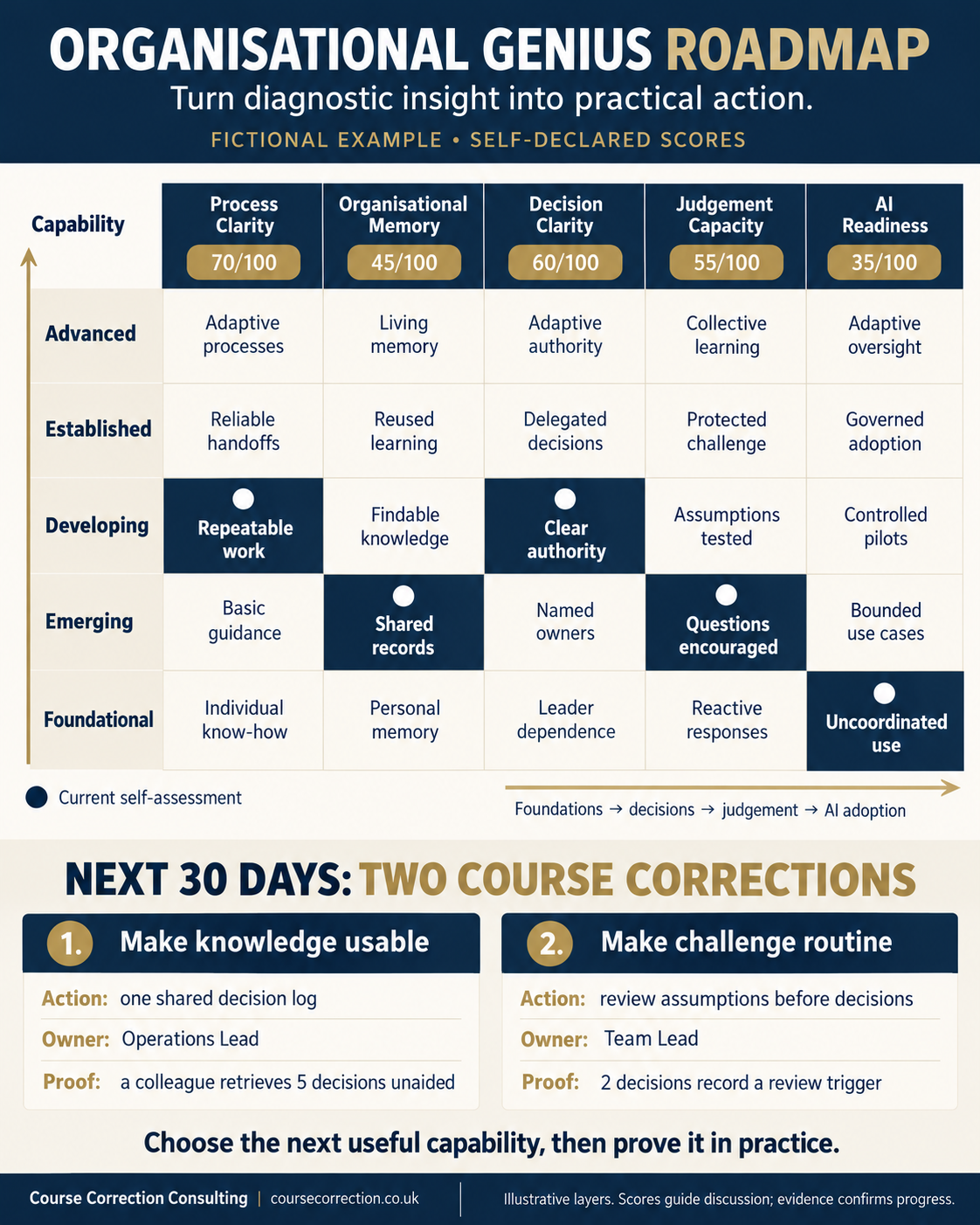
Build your Organisational Genius Roadmap with EASE. Explore a DIY assessment, choose practical next steps and discover support to turn your plan into action.
Start with what your organisation already does well. Use the roadmap to explore your current capabilities, compare perspectives and select one or two priorities connected to your ambitions. Your lowest selection is not automatically your highest priority. Turn each priority into an action with an owner, review date and observable evidence. The diagnostic surveys add structured questions; a Done with You session helps you interpret what you discover and agree practical next steps.
Build on what already works by choosing one or two capabilities that would make your next ambition easier to achieve.
The Organisational Genius Roadmap is a guided reflection across process clarity, organisational memory, decision clarity, judgement capacity and AI readiness. Use the visual, test your choices against recent examples and agree an action, owner, review date and evidence of progress.
Begin with the DIY interactive roadmap, explore the diagnostic surveys or ask about a Done with You roadmap session.
LEAD with EASE: a practical way to explore your organisation’s next possibilities
There is a particular satisfaction in seeing something you have helped to build begin to work. Customers return. Colleagues grow in confidence. Problems that once seemed unfamiliar become manageable. The organisation develops its own ways of getting things done, shaped by experience, relationships and the judgement of the people within it.
Much of that capability may never have been formally designed. People learned together, responded to circumstances and found approaches that worked. Someone became the person others trusted with a difficult customer. Someone else developed an instinct for spotting a problem before it became expensive. Decisions could be made quickly because the people involved understood one another and shared enough background to know what mattered.
These are achievements worth recognising. They also provide the starting point for an interesting question: what would help more people contribute to that success, more consistently, as the organisation moves towards its next ambition?
Perhaps you already have something in mind. You would like a colleague to take greater ownership of a customer relationship. You want the team to make certain decisions with more confidence. You can see an opportunity to use AI, provided people have reliable information and understand how to check its output. Or you would simply welcome more time to think, knowing that important work can continue without your involvement at every stage.
The Organisational Genius Roadmap is intended to help you explore those possibilities and choose a practical next step.
Organisational development can begin with a conversation about what people want to preserve. If customers value the personal care they receive, how might that care become something the wider team can reliably provide? If the organisation benefits from an experienced leader’s judgement, how might colleagues gain access to some of the reasoning behind it? If informal conversations enable quick decisions, what would help that responsiveness survive as more people become involved?
Research on organisational routines offers a useful perspective here. Feldman and Pentland (2003) distinguish between the general understanding of how a routine works and the particular actions through which people carry it out. Their theoretical argument is that routines can generate both stability and change, because people continually interpret and adapt them in practice. Familiar ways of working can therefore provide material for development, as well as continuity.
For a business leader, I think the practical implication is encouraging. You can begin by examining something that already works and asking what makes it possible. That may reveal knowledge worth sharing, authority worth clarifying or a useful practice that others could adapt. Development becomes an extension of experience, with the people doing the work helping to shape what happens next.
This is the spirit behind the roadmap. It offers a way to make those possibilities visible, discuss them and decide which deserve attention. I explore the broader idea in What Is Organisational Genius? The Power of Collective Capability.
The accompanying visual brings together five areas: process clarity, organisational memory, decision clarity, judgement capacity and AI readiness. Each column describes a different aspect of organisational capability, while the descriptions within it suggest ways that capability might become more established and adaptable.
Process clarity concerns how people understand and coordinate the work. Organisational memory concerns how experience remains available and useful beyond the moment in which it was acquired. Decision clarity explores who can decide, within what boundaries and with whose involvement. Judgement capacity considers how people examine evidence, question assumptions and learn together. AI readiness asks what would enable the organisation to use AI purposefully, with appropriate human responsibility and oversight.
These areas interact. A colleague may have clear authority to make a decision but still need access to the history of a customer relationship. A team may have excellent information yet benefit from more deliberate discussion of the assumptions behind a proposal. An AI pilot may become more useful once people agree which problem it is intended to address and who will evaluate its results.
The roadmap makes these relationships easier to explore. It does not imply that every organisation should pursue the same sequence or reach the highest box in every column. The appropriate capability depends on the work, the risks, the people and the ambition. The research discussed here informs the approach; it does not establish these particular boxes as a universal or validated developmental ladder.
Open the interactive roadmap and explore your own organisation’s next possibilities.
The simplest DIY approach is to look at each column and choose the description that most closely resembles your everyday experience. Take your time with this. A recent example will usually tell you more than a general impression.
If you select “Findable knowledge”, consider the last occasion when someone needed information about a previous decision. Could they locate it? Could they understand why the decision had been made? Was the information sufficiently current and clear to use? If you select “Clear authority”, think about a decision that arose last week. Did the people involved understand who could make it, and did that person feel able to proceed?
“Unsure” is a useful response. It identifies something you may want to investigate. You might know how a process works from your own position while being less certain about how a new colleague experiences it.
Once you have made your selections, invite someone else to complete the exercise independently. Choose a colleague whose work gives them a different view of the organisation. When you compare the maps, explore the examples behind each choice. Two different answers may both make sense because they describe different teams, customers or situations.
The quality of that conversation matters. In her study of 51 manufacturing teams, Amy Edmondson (1999) found an association between psychological safety and team learning behaviour. The study provides evidence for taking the interpersonal conditions of learning seriously, including whether people feel able to ask questions and discuss difficulties. It does not mean that agreement, comfort or an attractive workshop will automatically produce better performance.
My application of that research is to begin with curiosity: “What have you experienced that led you to choose that box?” This gives people room to explain their view and helps the organisation develop a more useful understanding of itself. For a wider discussion of how teams build that understanding, see What Is Organisational Judgement, and Why Does AI Make It More Important Than Ever?
Once your current position is visible, it can be tempting to focus immediately on the lowest selection. There may be good reasons to do so, particularly where an important risk needs attention. But the map also allows a more strategic conversation about what you want to make possible.
Suppose your next ambition is to bring a new manager into the business. The most useful priority may be decision clarity, supported by access to the knowledge that will help that person exercise judgement. If you want to provide a more consistent customer experience, process clarity and reliable handovers may deserve attention. If you want to explore AI, a bounded use case with clear ownership may offer more value than a broad technology programme.
The question becomes: which capability would help us achieve something we already care about?
There is a psychological reason to preserve that sense of choice. Gagné and Deci’s (2005) application of self-determination theory to work distinguishes between different forms of motivation, including the extent to which people experience their actions as autonomous. Their account highlights autonomy, competence and relatedness as important conditions for motivation. A practical inference is that people should have a meaningful role in understanding and shaping the changes they are being asked to carry forward.
The roadmap is therefore most useful when it helps you and your colleagues reach a conclusion you can explain in your own words: “This matters to us, this is why it matters now, and this is what we are prepared to try.”
A useful priority still needs to become something people can do. “Improve organisational memory” expresses an intention, but leaves considerable room for interpretation. A more practical action might be to record the reasoning behind significant customer decisions in one shared location and test whether another colleague can retrieve and use it.
The fictional example in the visual takes this approach. It connects an intended improvement to an action, an owner and observable evidence. You can add a review date and agree what support the owner will need. The resulting plan should make it easier to begin and easier to judge what happened.
Locke and Latham’s (2002) review of goal-setting research provides support for making goals specific and appropriately challenging, while recognising the importance of commitment, feedback, ability and task complexity. Clarity alone cannot compensate for missing resources or an unfamiliar task. Where people are still discovering how to do something, a learning goal may be more appropriate than an immediate demand for a performance result.
For the roadmap, that means an action might reasonably begin with investigation: test a handover, observe where a decision waits, or try a shared record with one customer team. You are creating a manageable opportunity to learn before deciding whether to extend the approach.
EASE provides a way to hold this process together. You Explore what is happening through examples and different perspectives. You Align around an ambition and the capability that would help you achieve it. You Support people with the information, time, authority and feedback required to act. You Empower them to make decisions within agreed boundaries and contribute what they learn.
These elements remain connected throughout the work. As people act, they discover things that may change the original plan. A knowledge problem may turn out to involve access permissions. A delayed decision may reflect uncertainty about commercial boundaries. A new process may work well in routine cases but need a clearer route for exceptions.
A review is an opportunity to understand those discoveries. Ask what became easier, what still required intervention and what you would adjust next. The value lies in the organisation’s growing ability to act and learn together, alongside the immediate improvement.
For the thinking behind the double mnemonic, read Why I Developed LEAD with EASE for Organisational Judgement. If delegated authority is one of your priorities, How Can Leaders Create Autonomy Without Losing Control? develops the practical relationship between freedom, boundaries and support.
The visual quick assessment gives you an accessible starting point. The Organisational Genius diagnostic surveys offer a more structured set of prompts for examining the same areas. You can use them before building a roadmap, or return to them when the visual raises questions you would like to explore more fully.
Their purpose is to support reflection and conversation. A self-reported score captures a person’s assessment, influenced by their role, experience and interpretation of the questions. It becomes more useful when considered alongside recent examples and the perspectives of others. A change in score may reflect a change in understanding as well as a change in capability.
You may therefore find that the greatest value comes from discussing why you answered as you did. The surveys help organise the enquiry; your organisation’s experience supplies the substance. The earlier newsletter, Organisational genius is collective capability, explains the diagnostic’s purpose and how to look beyond the headline score.
You can make a useful start with the picture alone. Select your current positions, discuss the examples behind them and choose one or two priorities. Give each priority an action, an owner, a review date and evidence that would help you judge progress.
As you do this, you may discover that the next step is clear. You may also find a conversation you would like help holding. Several priorities may compete for attention. Colleagues may have different experiences that need to be understood together. You may want to give someone more authority while carefully preserving the quality of service your customers value.
That is where the Done with You Organisational Genius Roadmap can help. We work through the map together, draw on the diagnostic surveys where useful and examine the practical examples behind your choices. We then translate your conclusions into a manageable plan, with clear ownership and the support required to begin.
You bring the experience, relationships and ambitions that give the organisation its character. I bring a structured process, an outside perspective and facilitation to help you decide what to carry forward.
Start by looking at the picture and asking yourself: what would I most like to become easier, more reliable or more widely shared?
If you would value support turning that answer into a practical roadmap, get in touch and mention “ROADMAP”. We can explore what a Done with You session would help you achieve.
You can also begin with the DIY interactive roadmap or explore the full diagnostic.
LEAD with EASE, small course corrections towards the organisation you want to build.
Edmondson, A. (1999). Psychological safety and learning behavior in work teams. Administrative Science Quarterly, 44(2), 350–383.
Feldman, M. S., & Pentland, B. T. (2003). Reconceptualizing organizational routines as a source of flexibility and change. Administrative Science Quarterly, 48(1), 94–118.
Gagné, M., & Deci, E. L. (2005). Self-determination theory and work motivation. Journal of Organizational Behavior, 26(4), 331–362.
Locke, E. A., & Latham, G. P. (2002). Building a practically useful theory of goal setting and task motivation: A 35-year odyssey. American Psychologist, 57(9), 705–717.