
TL;DR: I nearly called this the Lazy Manager’s Guide to Leadership. The joke contains a serious idea: do not celebrate repeated heroics when a better system can remove wasted effort. LEAD with EASE helps leaders create shared reality, clear decision rights, useful support and genuine delegated authority.
I have often joked that I could not call my approach The Lazy Manager’s Guide to Leadership. The thought has always been in the back of my mind, though, because there is a serious organisational lesson hiding inside the joke.
There is an old workplace story about two people who can be given a difficult task. Give it to the busy person and they will make room, work harder and get it done. Give it to the supposedly lazy person and they may find every shortcut, remove unnecessary steps and build a better system so the task does not require heroics next time.
I am happy to say that I lean towards the second instinct. I do not mean laziness as avoidance, indifference or leaving the burden to somebody else. I mean an intolerance for wasted effort, repeated friction and work that depends on the same heroic person rescuing it again and again.
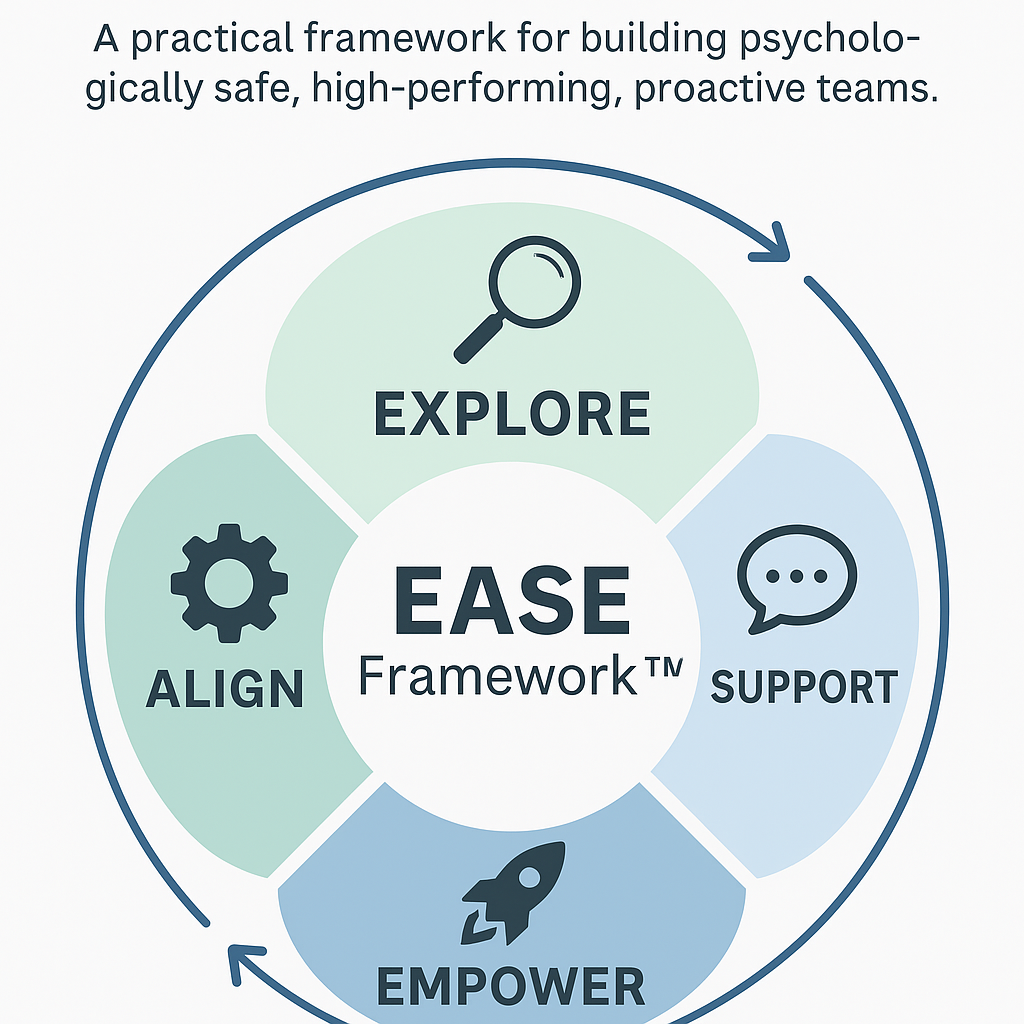
“Lead with ease” is an ordinary and attractive aspiration. It is not a phrase any one practitioner can sensibly claim as an idea. My contribution is the particular structure and application I began developing in April 2025 and first published on 23 July 2025: LEAD with EASE™ for Organisational Judgement.
It is a double mnemonic. LEAD describes the changing posture of a leader or facilitator. EASE describes the organisational journey that posture should enable.
Neither mnemonic is a rigid sequence. Leaders may need to move between learning, advising and delegating as the situation changes. Teams may discover during action that they must explore again or rebuild alignment.
Good leadership does not make demanding work effortless. It removes avoidable friction so effort can be spent where judgement, creativity and care actually matter.
A system that only works when the founder is available is not empowered. A process that depends on overtime is not efficient. A team that waits for permission on every unusual decision is not aligned. These are signs that the organisation is consuming people to compensate for weaknesses in its design.
Organisational judgement is the capability to establish, maintain and update a sufficiently shared understanding of reality so people can coordinate action under uncertainty. LEAD with EASE is intended to improve the conditions in which that judgement is exercised.
The outcomes I am looking for are practical: stronger shared reality, explicit decision rights, delegated authority, better decisions, improved wellbeing and less dependence on a founder or expert who is expected to know and rescue everything.
Leadership creates the conditions. Teams turn them into capability.
The supposedly lazy manager asks a useful question: why are we doing this the hard way again?
Sometimes the answer is that the work is genuinely difficult. Sometimes risk requires redundancy, checking and deliberate friction. But sometimes the difficulty is merely inherited: an unclear handoff, an unnecessary approval, knowledge held by one person, or a workaround that became the process.
LEAD with EASE gives leaders and teams a way to examine that difference together. The goal is not to work less responsibly. It is to stop confusing exhaustion with commitment and heroics with organisational capability.
Choose one recurring task that creates delay, rework or escalation. Ask:
That is a small course correction. Repeated consistently, it is how an organisation becomes easier to lead and more capable of leading itself.
Explore LEAD with EASE for Organisational Judgement, or start a conversation about applying it in your organisation.